

 Baby
Baby
Best Baby Activity Centers: What Age They're For and Which to Buy (2026)
 ·
April 28, 2026
·
April 28, 2026
A baby activity center is for roughly 4 to 12 months — it opens when your baby can hold their head up unsupported and sit with support, and it closes when they can pull to stand and climb out. That is a window of about six months, which is shorter than most parents expect and is the single most useful thing to know before you spend anything.
The complication is that four quite different products are sold under the words "activity center," and they do not share an age range. A floor play gym suits a newborn. A folding sit-up center suits a 6-month-old. A standing activity table suits a 1-year-old. What follows sorts them out by age, then names the pick for each stage — and, because it comes up in every conversation about this gear, explains why the sit-in wheeled walker is the one shape to avoid.
What age is a baby activity center for?

Most babies are ready for a seated activity center at around 4 to 6 months, and most have outgrown it by 10 to 12 months. Readiness is developmental, not calendar-based, so three things have to be true before your baby belongs in one:
- Independent head and neck control. Your baby can hold their head steady and upright, without bobbing or lolling, when you hold them seated. This usually settles between 4 and 5 months.
- Trunk control good enough to sit with support. They do not need to sit unaided yet, but they should stay upright in a supported seat rather than slumping sideways or folding forward.
- Feet that reach the floor or the base. On the lowest setting, the soles of both feet should rest flat. Dangling feet mean the seat is too high. Toe-tip contact means your baby is loading their weight through their toes instead of the whole foot.
That last one is what parents most often get wrong, and it is why height adjustment matters more than the number of toys bolted to the tray. If your 4-month-old cannot get their feet flat on the lowest setting, the center is still too big for them — wait a few weeks rather than propping the base up on a book.
The closing end of the window is easier to spot. Once a baby can pull themselves to standing on furniture, a seated center becomes a climb-out risk, and it is time to stop. For most babies that lands somewhere between 9 and 12 months.
Activity center age range by month

Here is the same question answered month by month, with what a baby is actually doing at each point and which shape of gear fits it. The ages in the right-hand column are the ones the brands themselves state.
| Baby's age | What they can do | What "activity center" means at this stage |
|---|---|---|
| 0-3 months | Lying on their back, batting at things overhead; short tummy-time stints | A floor play gym or a soft activity pad. No seat of any kind. |
| 4-5 months | Steady head control, rolling, reaching deliberately with one hand | The earliest a seated center is appropriate — and only if feet rest flat on the lowest setting. |
| 6-9 months | Sitting with support, then without; transferring toys hand to hand | Peak activity-center age. A sit-up center or folding panel is genuinely useful here. |
| 9-12 months | Pulling to stand, cruising along furniture, starting to climb | Time to stop using a seated center. Switch to a push-behind activity walker. |
| 12-18 months | Walking, squatting, carrying objects while upright | A standing activity table, at roughly 13 inches of table height. |
| 18-36 months | Sorting, stacking, matching, pretending | A busy box or activity cube — sat down at a table or on the floor. |
The practical takeaway: if your baby is under 4 months, you want a play gym, not a center. If they are over 12 months, you want a table, not a seat. The seated activity center only earns its floor space for the half-year in between — which is why the folding and convertible designs are worth the extra thought.
The four products sold as "activity centers"

1. Floor play gyms (birth to about 6 months)
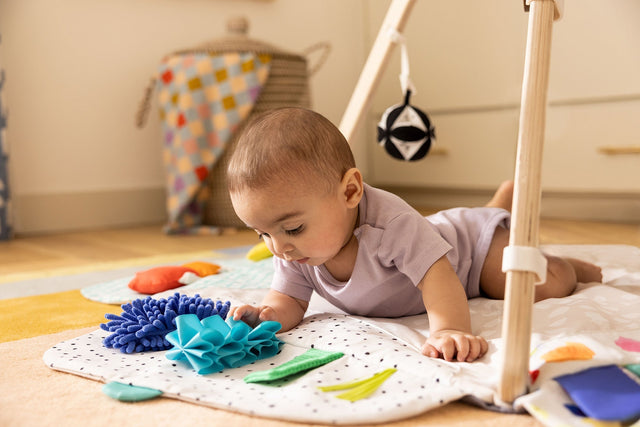
An arch or frame with toys suspended above a baby lying on their back. The skill being practiced is visually tracking an object and then reaching for it, which is why the toys hang at a fixed height rather than sitting in a tray. Plan Toys builds its Orchard gym on four legs specifically so the frame does not rock when a baby yanks on a toy, and both hanging toys detach so they carry on as rattles afterward.
2. Soft activity pads (birth to about 12 months)
A small padded panel, sewn with crinkle, rattle and squeak elements, that goes under a baby during tummy time or clips to a stroller. Wee Gallery's organic pads are 12 inches square with a maple teething ring attached — small enough to travel, which is the whole point of them next to a full-size gym.
3. Sit-up and folding activity centers (about 6 to 12 months)
The one that best matches what parents picture. A baby sits up and works panels of gears, spinners, sliders and mirrors with their hands. The folding versions are the most honest value at this age because they cover more than one position: laid out flat they are a tummy-time panel for a 4-month-old, folded into a triangle they are sit-up play at 7 months, stood on their side they are a tabletop toy at a year.
4. Standing activity tables and busy boxes (12 months and up)
Once a baby is upright, the toys move to table height so they can be reached standing. Janod's Meadow table stands 32 cm — about 12.6 inches — which is the height a new walker can reach without leaning on the tabletop for balance. Cube-shaped busy boxes cover the same activities in a form that works sitting down, which is why they keep going well past two.
One shape is missing from that list on purpose: the sit-in wheeled walker, where a baby sits in a suspended seat and scoots across the floor. That is covered further down, and it is the one thing here worth being firm about.
Best baby activity centers for each stage (2026)

Every age below is the one the brand states for that product; prices are today's. Anything not published by the brand — weight limits in particular — is left blank rather than guessed, so check the product page before you buy if that number decides it for you.
| Activity center | Best for | Brand-stated age | Price | The detail that matters | |
|---|---|---|---|---|---|
|
Play Gym - Orchard Plan Toys |
Newborn floor play | 0-6 months | $71.99 | Four legs stop the frame rocking when a baby pulls a toy; both suspended toys detach for later. |
 |
Organic Activity Pad - Safari Wee Gallery |
Tummy time and travel | 0-12 months | $69.00 | 12 inches square in organic cotton, with crinkle, rattle, squeak and a maple teething ring sewn in. |
|
Try-angle Foldable Activity Center Discovery Toys |
The 6-12 month sweet spot | 6-12 months | $48.00 | Folds flat (19.5" x 7") for tummy time, into a triangle for sit-up play, or upright for tabletop — three stages from one panel. |
 |
Awesome Activity Walker Wonder and Wise |
The step straight after a seated center | 9-24 months | $124.00 | Built for "sitters, squatters, standers and walkers" — the shape sorter works from the floor before your baby can push it. |
 |
Meadow Activity Table Janod |
First standing table | 12+ months | $76.99 | 32 cm (12.6") table height with seven activities, including a metal xylophone and a duck maze. |
 |
Sweet Cocoon - Activity Table Janod |
Sitting now, standing later | 12-36 months | $98.99 | Legs assemble two ways — 14 cm (5.5") for a seated toddler, 22.5 cm (8.9") once they play standing. |
|
Busy Box Wonder and Wise |
Longest run of use | 12-36 months | $144.00 | Solid wood and plywood, with a 12-shape sorting panel, gears, an abacus and a bead maze on top. |
 |
Shape Sorter Play Bench Tolo |
Small spaces and small budgets | 12+ months | $34.99 | 9" x 5.9" x 5.1" and 1.05 lbs — light enough for a toddler to carry, with the hammer tethered so it cannot wander. |
 |
Motor Skills Box Discovery Toys |
Older toddlers | 19+ months | $30.75 | Reversible top and more than seven separate motor activities, from fill-and-spill to raised numerals. |
If you buy only one thing for the 6-12 month window, make it a folding panel. A fixed seated center is used for about six months and then stored; a folding center covers tummy time before that window and tabletop play after it, which is a materially better return on the same floor space.
How long should a baby be in an activity center each day?

Cap a session at 15 to 20 minutes, no more than twice a day. Manufacturer instructions commonly print that ceiling themselves, and the reasoning is straightforward: any seat holds a baby in one fixed position, and rolling, pushing up onto forearms, pivoting and crawling can only be practiced on the floor. Container time is time subtracted from that, so it should be the exception rather than the default.
The rest of the rules are short and worth following every single session:
- Stay in the room. A baby in a seat is contained, not supervised. Never leave one unattended.
- Set the height before the first use, then re-check it monthly. Feet flat, not on tiptoes, not dangling. Babies grow faster than you will remember to adjust.
- Flat, stable floor only. Never on a table, a bed, a raised platform, or near the top of stairs. Thick carpet can let one leg sink and tip the base.
- Check the model against recalls before it is used — including anything handed down or bought secondhand — at cpsc.gov/Recalls.
- Stop when they can pull to stand. The ability to climb out arrives before the ability to land safely.
- Assemble it fully and re-tighten it. Wooden walkers and tables ship flat-packed; a loose leg on a standing table is what turns a lean into a fall.
Activity center vs. walker, jumper, play mat and table

Versus a play mat or gym: a mat works the floor skills — rolling, pushing up, pivoting, eventually crawling. A center works upright hand skills. They are not substitutes, and the mat should get more of the day. Our play gym guide covers that side in detail.
Versus a bouncer or rocker: a bouncer is a place to rest — a baby sits and is gently moved. A center is a place to work, where the baby does the moving. In the first months a bouncer is often the more useful purchase; from about 5 months the center starts earning its keep.
Versus a doorway jumper: jumpers hang from a frame and let a baby bounce by pushing off the floor. They are fun and they are also the easiest of these to overuse — keep sessions short, check that the clamp is fully seated on a solid frame every time, and prefer a freestanding base to a door-mounted one where you have the choice.
Versus a push walker: different age, different mechanics. A push walker suits roughly 9 to 14 months onward, once a baby is pulling up. Your baby stands behind it with both feet on the floor and pushes, which is a fundamentally different thing from sitting inside a wheeled frame. Our push walker guide goes through braking, wheel type and how much weight a new walker can lean on.
Versus an activity table: a table is the after — 12 months and up, played at standing. If you want the sizing worked out properly, the activity table and chair sizing guide has the height math by age.
Why the sit-in wheeled walker is the exception
The American Academy of Pediatrics has called for a ban on the manufacture and sale of infant walkers in the United States — the seat-on-wheels kind a baby rides in, not the push-behind kind. The research published alongside that call found that more than 230,000 children under 15 months were treated in US emergency departments for infant-walker-related injuries between 1990 and 2014, and that roughly three-quarters of those injuries came from falling down stairs while in the walker. Injury numbers dropped substantially after a federal mandatory safety standard took effect in 2010, but they did not stop.
Pediatricians who have studied those injuries point parents toward stationary gear instead: something that entertains a baby without moving them. That is exactly what a seated activity center, a play gym or a push-behind walker is. A push-behind wooden walker is a different machine altogether: a toddler stands, holds the handle and walks, with both feet on the floor, nothing enclosing them and no way to gather speed toward a staircase. That is the shape to look for in wooden baby walkers.
What comes next: activity walkers for 9-14 months

An activity walker is the natural successor because it does both jobs at once. The front panel carries the same gears, sorters, mirrors and bead mazes your baby was working in the seat, so it is useful while they are still sitting on the floor in front of it — and then it becomes something to push once they stand up. That overlap is why 9 months is a reasonable time to buy one, even though your baby will not push it for weeks.
Two things separate a good one from a frustrating one. The first is a brake: Speedy Monkey's Multi-activity Walker and Janod's Sweet Cocoon both have a wheel-blocking brake, which stops the walker shooting away from a baby who leans their weight on it too early. The second is mass: Mentari's Bambino Activity Walker weighs 7.67 lbs, and that weight is doing real work — a light walker skates, a heavy one resists.
Wonder and Wise's Awesome Activity Walker is the earliest-starting of these at a stated 9-24 months and is explicitly built for sitters as well as walkers, which makes it the cleanest handover from a seated center.
Activity tables: the 12-month step up

An activity table is what an activity center becomes once a baby stands. The height is the whole specification. Too tall and your toddler has to reach up, pulling themselves off balance; too short and they stoop. Around 12 to 14 inches of table height works for a new walker between 12 and 18 months.
The adjustable ones are the ones to look at first, because that number changes fast. Janod's Sweet Cocoon table assembles with legs in two positions, 5.5 inches for a toddler playing seated and 8.9 inches once they are steady on their feet. Wonder and Wise's Hi-lo Activity Table adjusts between sitting and standing height the same way and carries a much denser set of activities — a lake maze, a mirror, a ball cage, a peek-a-boo door — which is what stretches it to a stated 12-36 months.
If your toddler is nearer two and still enthusiastic, Janod's Dino table is listed 18-36 months and leans harder on pretend play than on pure cause-and-effect, which is the right direction of travel at that age.
Shop all activity centers at EasyTot →
Frequently Asked Questions
What age is a baby activity center for?
A seated baby activity center is for roughly 4 to 12 months. The earliest a baby should use one is around 4 to 5 months, once they have independent head and neck control and can sit with support, and most babies have outgrown one by 10 to 12 months when they start pulling to stand. Floor play gyms suit birth to about 6 months, and standing activity tables suit 12 months and up.
Can a 5 month old use an activity center?
Usually yes, if your 5-month-old can hold their head steady and upright without support and stays upright rather than slumping when seated. The deciding test is the feet: on the seat's lowest setting, both soles should rest flat on the base or floor. If they dangle, the center is still too big and it is worth waiting a few weeks.
What activity center is best for a 6 month old?
Six months is the sweet spot for a sit-up activity center, and a folding panel is the best value at that age because it covers more than one position. The Discovery Toys Try-angle Foldable Activity Center is listed for 6-12 months and lies flat for tummy time, folds into a triangle for sit-up play and stands upright for tabletop use.
What activity center suits a 9 month old?
At 9 months many babies are pulling to stand, which is the point to move on from a seated center. A push-behind activity walker is the better buy: the Wonder and Wise Awesome Activity Walker is listed 9-24 months and is designed for sitters as well as walkers, so its shape sorter and bead maze work from the floor before your baby is ready to push it.
How long should a baby be in an activity center?
Limit sessions to 15 to 20 minutes, no more than twice a day. Any seat holds a baby in one fixed position, and rolling, pushing up and crawling can only be practiced on the floor, so floor play should be the default and the seat the exception.
When should babies stop using activity centers?
Stop when your baby can pull themselves up to standing on furniture, typically between 9 and 12 months, or sooner if they reach the manufacturer's stated height or weight limit. The ability to climb out of a seat arrives before the ability to land safely, so the pull-to-stand milestone is the signal, not the birthday.
What is the difference between a jumper and an activity center?
A jumper suspends a baby from a door frame or a freestanding base so they can bounce by pushing off the floor. A stationary activity center holds a baby in a fixed seat surrounded by toys, with no bounce and no travel. Activity centers are generally the more forgiving of the two because a baby cannot build momentum in one.
Are baby walkers with wheels safe?
The American Academy of Pediatrics has called for a ban on the manufacture and sale of sit-in infant walkers in the United States. Research published alongside that call found more than 230,000 children under 15 months were treated in US emergency departments for infant-walker-related injuries between 1990 and 2014, with roughly three-quarters of those injuries caused by falls down stairs. Stationary activity centers and push-behind wooden walkers, which a baby stands behind rather than sits inside, do not carry that risk.
What height should an activity table be for a 1 year old?
About 12 to 14 inches of table height suits a toddler between 12 and 18 months, so they can reach the surface standing without leaning on it for balance. Adjustable models cover more of that growth: the Janod Sweet Cocoon table assembles at 5.5 inches for seated play or 8.9 inches for standing play.
Keep reading
 GearIs the Freshly Picked Diaper Bag Worth It? Real Parent Reviews (2026)
 GearBIBS vs. Frigg vs. Soothie: The Pacifier Your Baby Will Actually Take (Real-Parent Tested, 2026)
 GearLorena Canals Washable Rugs Review: Are $200-$600 Machine-Washable Rugs Worth It?
 GearCharlie Crane LEVO Rocker Review: Is the $309 Instagram Rocker Actually Worth It?
 GearDoona Car Seat Stroller Review: What 500+ Real Parents Actually Think
 GearBest Baby Loveys & Security Blankets (2026)
 GearBest Push Walkers for Babies: First Steps Guide (2026)
 GearLovevery Play Gym Review: Is It Worth It? What 161 Real Parents Say (2026)
 GearBest Baby Towels & Washcloths 2026: Softest Picks by Fabric
 GearBest Bath Toys for Babies & Toddlers 2026: Safe & Fun Picks
 GearBest Baby Bathtubs of 2026: Safest Picks for Every Stage
 GearBest Teethers & Rattles for Babies 2026
 GearKids Activity Tables and Chairs: The Complete Sizing Guide