

 Baby
Baby
Lovevery Play Gym Review: Is It Worth It? What 161 Real Parents Say (2026)
 ·
April 28, 2026
·
April 28, 2026
If you've shopped for a baby play gym, you've met exactly one famous name: the Lovevery Play Gym. It out-searches every other brand by about 30×, so the question nearly every parent ends up Googling is simply — is the Lovevery Play Gym actually worth it? To answer it honestly we read 161 real parent comments across four Reddit threads debating exactly that, measured the search data, and lined the Lovevery up against every other play gym worth knowing — including several lovely ones we carry that rarely get a mention. Here's the verdict, the verbatim quotes, and all the alternatives.
We read 161 verbatim comments from parents across four Reddit threads (r/beyondthebump, r/BabyBumps and r/NewParents) who owned or tried the Lovevery Play Gym and its rivals, measured Google search-volume share for the category, and matched it against the play gyms we carry. We lead with what real parents report. Every quote is verbatim.
First, the market: Lovevery basically is the category
Most product categories have a few big players. Play gyms have one — by a landslide:
So… is the Lovevery Play Gym worth it?
We read 161 comments from parents who actually owned or tried it. The honest answer: it's split.
Four patterns explain the split — and they'll tell you which camp you're in:
Our take: the Lovevery is worth it if you value build quality, a calmer aesthetic and strong resale, and you'll use its sensory features as your baby grows past 4 months. If you mostly want maximum baby-entertainment per dollar right now, a Fisher-Price Kick & Play will likely make your baby just as happy for a fraction of the price — and if you want the Lovevery's design-forward feel with a different look, we carry a handful of beautiful alternatives below.
Play gyms by type — quick comparison
Pick the lane that fits your priorities. Every product links straight through.
| Play gym | Type | Price | Mat included? | Best for |
|---|---|---|---|---|
| The all-rounder (Montessori-leaning) | ||||
| Lovevery The Play Gym | Fabric arch + sensory zones | $150 | Yes — padded mat | Quality, calm design, grows 0–12m+, great resale |
| The budget champion (most fun per $) | ||||
| Fisher-Price Kick & Play Piano Gym | Plastic arch + kick piano | ~$45 | Yes — soft mat | Lights/music babies adore; packs down small |
| Wooden & Montessori — arch only, bring your own mat | ||||
| Plan Toys Pastel Play Gym | Sustainable wood + hanging toys | $90 | No — add a mat | Eco wooden gym at a friendly price |
| Peariwinkle Montessori Play Gym | Wooden tripod + Montessori mobiles | $127 | No — add a mat | Authentic newborn Montessori; converts to a tent |
| Charlie Crane Naho Arch | Beech wood arch | $212 | No — add a mat | Heirloom looks; pair with your own mat |
| Airplane Baby Play Gym | Handmade USA wood frame | $80 | No — add a mat | Toys detach to clip on a stroller or car seat |
| Tummy-time mats — pair with any arch-only gym above | ||||
| Malabar Baby Tumble Mat | Cotton, water-resistant | $80 | It's the mat | Budget-friendly; lightweight & foldable |
| Wee Gallery Safari Playmat | Organic high-contrast | $114 | It's the mat | Newborn high-contrast tummy time |
| Charlie Crane Tami Play Mat | Plush French foam | $135 | It's the mat | OEKO-TEX foam; matches the Naho arch |
| Toki Organic Cotton Mat | Organic cotton + foam | $185 | It's the mat | Designer, reversible, washable cover |
| Gathre Padded Mini Playmat | Vegan leather, wipeable | $200 | It's the mat | Cushy; matches the Gathre look |
Lovevery Play Gym — what you're actually paying for

The Lovevery is a fabric play gym with a wooden arch, five sensory "zones," high-contrast cards, a mirror, a wooden batting ball and a teether, plus a stage-by-stage play guide. It's designed to be reconfigured as your baby develops from the newborn "looker" phase through sitting and pulling up.
What parents love: the calm, less-overstimulating design and the quality of the hanging toys — "I found it worth it… less over stimulating… the toys that hang are just better quality." The high-contrast cards and mirror are repeat winners ("he'll visibly light up as soon as he sees them"), the big mat means baby stays put when they start rolling, and the Velcro lets you swap what hangs. And it's built like a tank: "3 different families have owned it and it's pristine."
What parents flag: price, size, and a short, late window. Many babies don't engage until ~4–6 months; it's also big — a repeated complaint is that it's bulky and not easily collapsible ("you should know that it's HUGE… we replaced it with a kick and play piano"), though others note the size becomes a plus once baby can sit up under it. The fabric mat absorbs spit-up and attracts pet hair, and value skeptics are blunt: "I don't think I should have to add anything to a $150 play gym." The most-repeated money-saver: buy it secondhand — parents routinely snag near-new ones on resale sites (or via Target Circle sales) for $60–85.
Bottom line: a genuinely high-quality, calm, long-lasting gym that holds its value — worth it if you'll use it past 4 months and value the build. If you want maximum giggles-per-dollar today, read the next pick first.Shop the Lovevery Play Gym
Fisher-Price Kick & Play — the budget champion
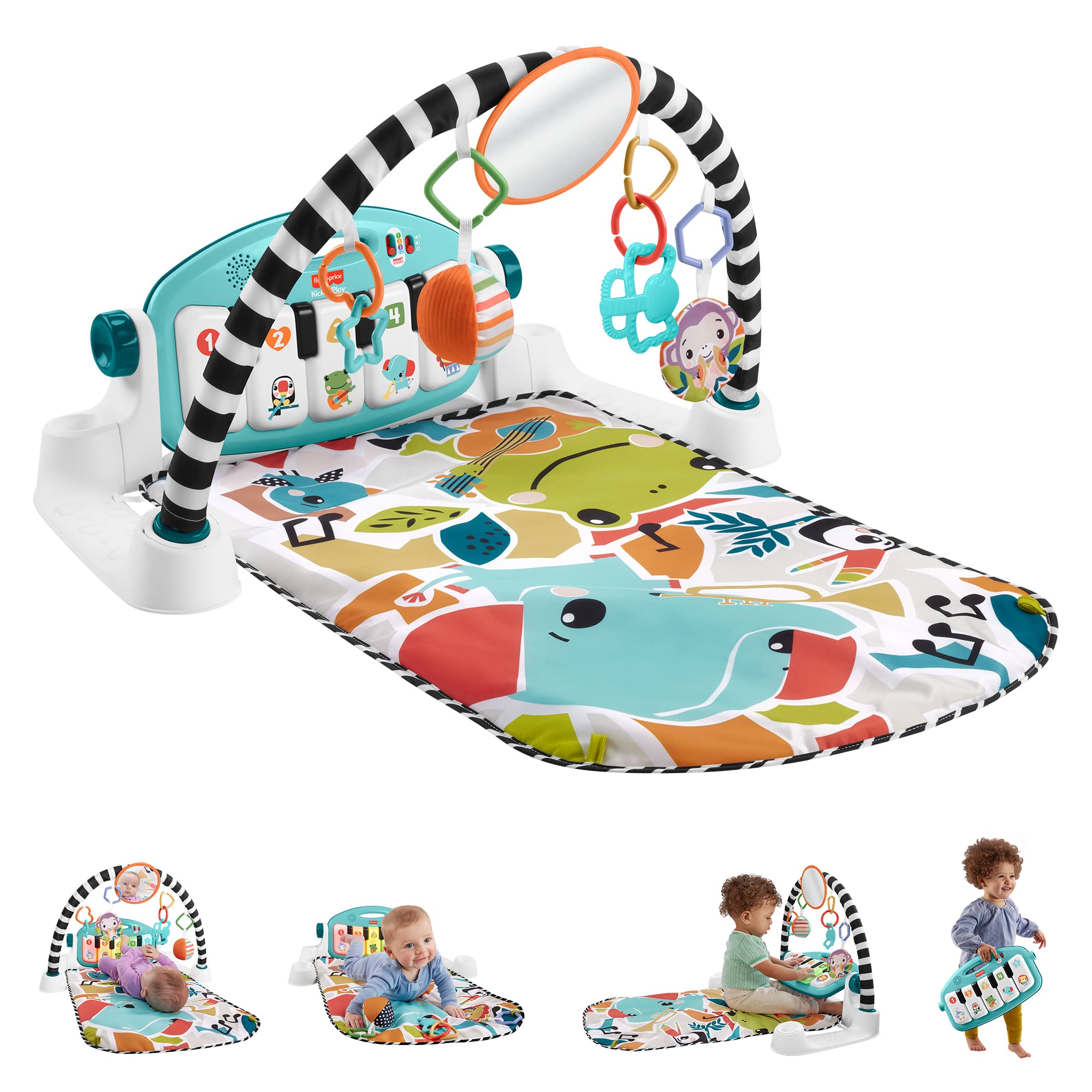
The name that comes up again and again as the cheaper thing babies actually go nuts for. The Fisher-Price Kick & Play Piano Gym (~$45) has a kick-activated piano with lights and music, and parents are unabashed about it: "the kick and play piano is where it's at!!!" and "a bright colorful fisher price one that was maybe $40 and he loved it. Kept him busy and entertained." One parent affectionately calls it "infant tv."
It's plastic and not nursery-pretty, and the lights/music are the opposite of the Lovevery's calm restraint — but it packs down small and buys you real hands-free minutes. Many parents even hang its piano or toys on a nicer arch to get the best of both. If your budget is tight or you just want the surest baby-pleaser, start here.
See the Fisher-Price Kick & PlayGathre — the design-forward alternative
If your only hesitation with the Lovevery is the look, Gathre is the design brand to know. Gathre is known for its buttery vegan-leather mats, which wipe clean in a second (no machine-washing) and genuinely look like décor rather than baby gear — its Padded Mini Playmat ($200) makes a wipeable floor for any of the arch-only wooden gyms here. As your child grows, the Gathre Play Gym ($250) and the wooden Play Gym Slide ($200) step things up.
Plan Toys — the eco wooden gym

Want the warm wooden look without a $200+ price tag? The carried Plan Toys Pastel Play Gym ($90) is the value sweet spot in wood. Plan Toys is a well-loved sustainable toy maker (their gym is made from responsibly sourced rubberwood), and this one keeps the calm, Montessori-friendly aesthetic with gentle pastel hanging toys — at little more than half the Lovevery's price. A great middle ground for parents who want "nice and wooden" without splurging. One thing to know: like every wooden gym here, it's the frame only — it doesn't include a mat, so plan to add one (see below).
Shop the Plan Toys Play GymCharlie Crane — the wooden heirloom arch

For the purest minimalist, the carried Charlie Crane Naho Arch ($212) is a beech-wood frame with three soft hanging toys that looks like furniture, not baby gear. It's the "heirloom" route — pair it with any mat you like and swap in your own toys. The trade-off is honest: it's feature-light, so it's about aesthetics and longevity, not maximum stimulation. There's also a lower-priced LEVO arch ($164) made for their rocker.
Shop the Charlie Crane NahoWee Gallery — the high-contrast tummy-time mat

Newborns can't see much color yet, which is why high-contrast art is what actually holds their gaze in the first months — exactly the thing parents in our threads said their babies stared at most. The carried Wee Gallery Safari Playmat ($114) leans into that: a double-sided organic-cotton mat with hand-illustrated, high-contrast animals for tummy time, no arch attached. Want the arch and toys too? The Little Safari Bundle ($160) adds a sensory set. A lovely, less-plastic newborn option if you don't need the full staged system.
Shop the Wee Gallery PlaymatPeariwinkle — the Montessori newborn set

For a true Montessori setup, the carried Peariwinkle Montessori Play Gym ($127) is the one purpose-built for the newborn stage. Its slim wooden tripod frame is sized to hang the classic Montessori visual mobiles (Munari, then Gobbi) at exactly the right height for a baby lying on their back, and it later converts into a little play tent as your child grows. It's the pick for parents who want the authentic Montessori progression rather than a busy all-in-one — pair it with a soft mat (see below) and you're set.
Shop the Peariwinkle Play GymAirplane Baby Play Gym — handmade in the USA

The carried Airplane Baby Play Gym ($80) is a charming made-in-USA pick, handmade in Lancaster, PA. The airplane-shaped wood frame is cute on its own, but the clever part is that the hanging toys detach and loop onto a stroller, car seat or high chair — so the entertainment travels with you. US safety-tested with no small loose parts. Like the other wood frames, it's arch-only.
Shop the Airplane Play GymIt's the detail that catches parents off guard. Only the Lovevery comes with its own padded mat. Every other wooden gym here — Charlie Crane, Plan Toys, Peariwinkle and the Airplane — is just the arch or frame: it hangs over your baby and assumes you'll supply the floor surface. So with any of those, plan to buy a tummy-time mat separately, or baby ends up batting at toys on a hard floor.
Carried mats that pair beautifully with an arch (cheapest first):
- Malabar Baby Tumble Mat ($80) — lightweight, water-resistant cotton; the budget-friendly pick.
- Wee Gallery Safari Playmat ($114) — organic cotton with newborn-friendly high-contrast art.
- Charlie Crane Tami Play Mat ($135) — plush 3cm French foam (OEKO-TEX certified); the natural match for the Charlie Crane arch.
- Toki Organic Cotton Mat ($185) — designer organic-cotton-over-foam mat, reversible and machine-washable cover.
- Gathre Padded Mini Playmat ($200) — cushy, wipeable vegan leather that matches the Gathre look.
More options worth knowing
- Skip Hop — the popular mid-price middle ground (cute prints, ~$45–90). Honest caveat from the threads: smaller mats can let a rolling baby "roll right off after one roll."
- Baby Einstein — another budget kick-piano favorite parents called out by name ("my toddler still uses the piano… highly recommend").
- Tiny Love Gymini — the classic colorful arch-and-mat; a solid, affordable all-rounder.
How to choose (without overspending)
Full lineup at a glance
| Play gym | Price | Why pick it |
|---|---|---|
| Lovevery The Play Gym | $150 | Quality, calm, grows with baby, great resale |
| Fisher-Price Kick & Play | ~$45 | Budget champion; lights/music babies love |
| Plan Toys Pastel Play Gym | $90 | Eco wooden gym at a friendly price |
| Peariwinkle Montessori Play Gym | $127 | Newborn Montessori tripod; converts to a tent |
| Charlie Crane Naho Arch | $212 | Wooden heirloom look; pairs with any mat |
| Wee Gallery Safari Playmat | $114 | Organic high-contrast newborn tummy time |
| Airplane Baby Play Gym | $80 | Handmade in the USA; toys detach to clip on the go |
Play gym FAQ
Is the Lovevery Play Gym worth it?
It's genuinely split among parents. It's worth it if you value high build quality, a calm (non-flashing) design, and strong resale value, and you'll use its staged sensory features as your baby grows past ~4 months. If you mainly want the most baby-entertainment per dollar right now, a ~$45 Fisher-Price Kick & Play makes many babies just as happy. A popular middle path is buying the Lovevery secondhand — they hold up extremely well.
What's a good alternative to the Lovevery Play Gym?
Depends on why you're looking. For the wooden aesthetic cheaper, the Plan Toys Pastel Play Gym ($90) or Charlie Crane wooden arch are great. For pure value and baby engagement, the Fisher-Price Kick & Play (~$45) is the cult budget pick. And for a newborn, a simple high-contrast mat like Wee Gallery's is often all you need.
At what age do babies actually use a play gym?
Most babies engage a play gym from around 3–6 weeks (staring at high-contrast cards and a mirror) and get the most out of it from ~4–6 months when they bat, kick and reach for toys. Many parents report their newborn ignored it at first and "clicked" closer to 4 months — so don't write it off early. The active window typically runs until baby starts crawling.
Is the Lovevery Play Gym just "sad beige"?
No — that's a common myth. The Lovevery Play Gym is actually quite colorful (parents correct this constantly in threads). What people mean is that it's calmer than a lights-and-sounds plastic gym, which fans see as a feature (less overstimulating) and skeptics see as paying for aesthetics. It's a preference call, not a fact about the product.
Do I need the Lovevery subscription play kits too?
No — the Play Gym stands on its own. Interestingly, some parents rate the subscription play kits even higher than the gym itself, and a few buy only the kits plus a cheap mat. The gym comes with its own toys and cards; the kits are an optional add-on, not a requirement.
Sources: 161 verbatim parent comments coded from four Reddit threads on r/beyondthebump, r/BabyBumps and r/NewParents (2021–2026); Google Keyword Planner U.S. search volumes. Prices approximate and subject to change.
Keep reading
 GearToki Mats Review: Organic Cotton vs Vegan Leather, Sizes, and Is It Worth It
 GearIs the Freshly Picked Diaper Bag Worth It? Real Parent Reviews (2026)
 GearBIBS vs. Frigg vs. Soothie: The Pacifier Your Baby Will Actually Take (Real-Parent Tested, 2026)
 GearLorena Canals Washable Rugs Review: Are $200-$600 Machine-Washable Rugs Worth It?
 GearCharlie Crane LEVO Rocker Review: Is the $309 Instagram Rocker Actually Worth It?
 GearDoona Car Seat Stroller Review: What 500+ Real Parents Actually Think
 GearBest Baby Loveys & Security Blankets (2026)
 GearBest Push Walkers for Babies: First Steps Guide (2026)
 GearBest Baby Activity Centers: What Age They're For and Which to Buy (2026)
 GearBest Baby Towels & Washcloths 2026: Softest Picks by Fabric
 GearBest Bath Toys for Babies & Toddlers 2026: Safe & Fun Picks
 GearBest Baby Bathtubs of 2026: Safest Picks for Every Stage
 GearBest Teethers & Rattles for Babies 2026
 GearHigh Contrast Baby Toys: A Stage-by-Stage Guide