
 Baby
Baby
High Contrast Baby Toys: A Stage-by-Stage Guide
 ·
September 7, 2026
·
September 7, 2026
Last updated: September 2026
High contrast baby toys are black, white and sometimes red patterns designed for the one stretch of life when a baby cannot yet make sense of soft color. In the first weeks, a newborn focuses best at roughly 8 to 12 inches and separates shapes by edges rather than hue, so a hard black line on white is far easier to lock onto than a pale gray bunny on a cream blanket. That is the whole idea, and it is also why the category has a short shelf life.
This guide is organized around what a baby can actually see at each stage: what to offer in the first weeks, what changes at tummy time, what works from around five months, and when black and white stops being the point. Everything named here is a real high contrast baby toy you can buy today, from a $10 board book to a $131 playmat-and-muslin bundle.
Start with cards, not gear. A $17-$26 set of black and white cards does the same job in the first six weeks as a $94 mat, and it fits in the diaper bag. Add a mat or a padded strip when tummy time starts. Skip anything that promises a developmental outcome — the honest pitch is that these patterns are easy for a brand-new baby to look at.
What newborns can actually see
A newborn's eyes work, but not the way yours do. Focus is fixed at close range for the first weeks — roughly the distance from your elbow to your hand when you are holding the baby, about 8 to 12 inches. Fine detail is not there yet, and neither is the ability to tell apart two colors of similar lightness. Put a pastel pink duck on a pale yellow background in front of a two-week-old and the whole thing reads as one soft blur.
Black against white is the opposite problem to solve: the edge is absolute. That is why every product in this category is built from thick lines, wide stripes, concentric circles, dots and simple animal silhouettes rather than shading or gradients. Red shows up in a lot of sets for the same reason — strong red against white holds an edge that a pastel cannot.
Two practical consequences follow, and they are the reason most parents feel let down by their first purchase. First, the pattern has to be big; a busy monochrome print with tiny motifs is decoration for the nursery, not something a newborn can resolve. Second, position beats price. A $26 card held 10 inches from a baby's face outperforms a $97 mat lying flat on the floor two feet below them.

For background reading on how sight develops over the first year, the American Academy of Ophthalmology and the American Optometric Association both publish plain-language overviews, and MedlinePlus covers newborn development more broadly. None of them sell toys, which makes them a useful sanity check against packaging copy.
Black and white baby toys: cards, books and flashcards
Cards are the best first purchase in this category and the cheapest. They are held at the right distance by definition, they travel, they can be propped in a bassinet or a stroller, and when the baby is done with them in a few months they cost less than a single playmat.
Wee Gallery Art Cards for Baby are the ones most parents land on: six hand-drawn animals per set, printed 5 by 7 inches on board with matte lamination and rounded corners, at $26. The matte finish is the detail that matters in daylight — gloss throws a reflection right where the baby is looking. The Black and White Collection is the strict monochrome set; the Original and Woodland sets add a little more line detail for older babies.

Curious Baby Cards takes a different format for $17: 24 high-contrast images on thick water-resistant stock, ring-bound so the set fans open and cannot be scattered across the floor by a foot. The listing puts it at 0-3 months. Ring-binding is genuinely better in a car seat or stroller; loose cards are better for propping around a bassinet. That is the whole decision.
Etta Loves Sensory Flashcards sit between the two at $20 — 12 cards, with affirmations printed on the reverse for the adult holding them and one card of usage ideas. If cards feel too clinical, The Little Rose Shop makes a high-contrast board book at $10, which is the cheapest way into the category and survives being gummed.
High contrast toys for tummy time: play mats, gyms and strips
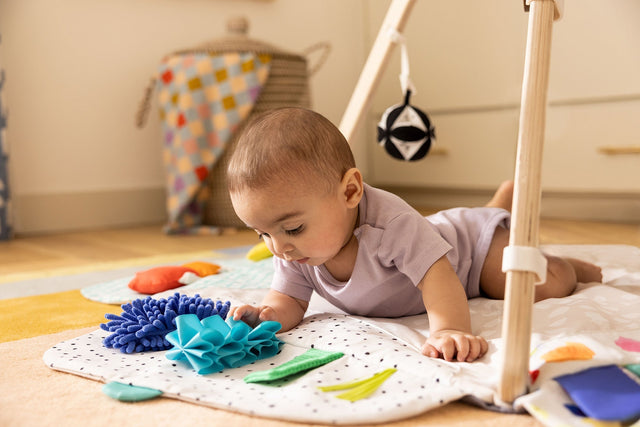
Tummy time is where high contrast toys stop being a nice idea and start doing a job. A baby on their front will only hold their head up if there is a reason to, and a strong pattern placed at the right height is that reason. Flat on the floor underneath them is the wrong height — the target needs to be in front of their face, standing up.
Etta Loves builds for this directly. The Animal Sensory Strip and Plant Print Sensory Strip ($38) are padded organic-cotton panels that stand up on their own during tummy time and tie around the edge of a stroller the rest of the day. Each is reversible: one side designed for newborn to 4 months, the other for 5 months and up. That reversibility is the single best answer to the "how long will this last" question in this whole category.

The playmats are the premium end: the Plant Print and Animal Print mats are $94, the Etta Loves x Keith Haring mat is $94 and the Walala Studio mat is $97. All four are reversible on the same newborn-to-4-months and 5-months-plus logic, in padded organic cotton. What you are paying for is the padding and the size, not the print — and that is a fair thing to weigh against a plain quilted mat plus a $26 set of cards. Our guide to baby play mats and gyms covers the padding-and-size question in more detail.
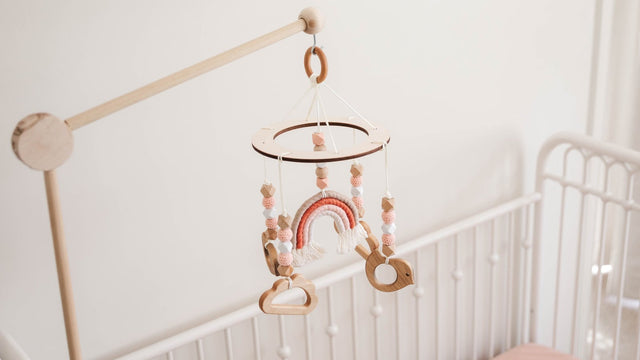
For a frame rather than a mat, Plan Toys makes the only wooden high-contrast play gym here at $89.99: a four-legged rubberwood structure with two detachable high-contrast toys hanging from it, finished with water-based dyes. The detachable part matters — the toys come off and carry on being toys once the gym is outgrown.
High contrast muslins, loveys and blankets
Be clear about what these are: they are muslins and comforters printed in high-contrast patterns, not toys. Most of what gets shelved under "high contrast" is textile, and a parent shopping for a toy should know that before they add a three-pack of muslin squares to the cart.
Used properly they earn their place anyway. A large monochrome muslin draped over the side of a bassinet, clipped to a stroller, or spread under a baby during floor time gives a big, bold pattern at very little cost per use — Etta Loves squares run $27-$36 for singles and three-packs, with XL prints at $28 and full reversible blankets at $63-$68. Etta Loves says its prints were developed with a consultant orthoptist, and the visual logic shows: wide spacing, few motifs, nothing fussy.

The loveys are the same fabric shrunk to a $24 comforter square. They are lovely, and they are a supervised-play item for a newborn, not a crib item — keep the sleep space empty and save the attachment object for later. If a comfort object is what you are actually shopping for, start with our guide to baby loveys and security blankets instead, and see the safest crib toys guide for what belongs near a sleeping baby.
Teethers and bath toys for babies who reach
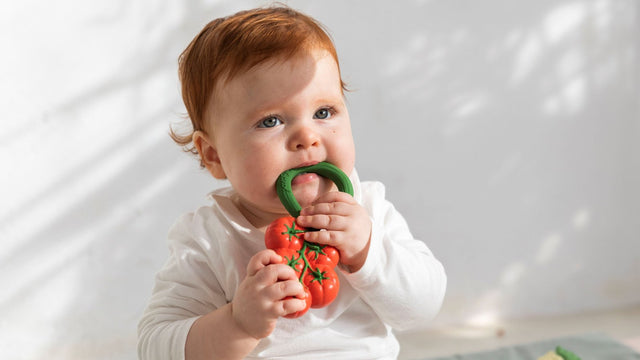
Somewhere around three to four months, looking turns into grabbing, and a pattern that only works at a distance stops being enough. This is the point to switch to something with a graspable shape.

The Natural Rubber Sensory Bath Toys three-pack ($38) is the one worth knowing: hand-painted patterns on one face, raised texture on the reverse, fully sealed so water cannot get inside and grow anything. Fully sealed is not a given in bath toys, and it is the reason this set survives past the mold problem that ends most squeezy toys. For the wider category, see our roundup of teethers and rattles.
0-3 months toys: what to use, week by week
The honest answer to "what toys does a 0-3 month old need" is: almost none, plus something to look at. Here is how the looking changes, and what to put in front of it.
| Stage | What the looking is like | What to put in front of it |
|---|---|---|
| Weeks 0-3 | Brief, close, mostly while being held. Long stretches of sleep in between. | One card at a time, held 8-12 inches away, for as long as the baby stays interested — often under a minute. |
| Weeks 4-6 | Fixing on a pattern and holding it. Beginning to track a slow-moving object side to side. | Cards propped at the side of the bassinet or stroller at eye level. Move one slowly across their field of view. |
| Weeks 7-10 | Head control building. Tummy time becomes possible for a minute or two at a stretch. | A padded strip stood upright in front of them, or a mat with a bold print. Something to lift the head toward. |
| Weeks 11-14 | Batting and swiping. Hands come to the middle. Eyes and hands start working together. | A play gym with hanging high-contrast toys, or a teether they can hold while looking at it. |
| 4-5 months | Grabbing on purpose, mouthing everything, rolling. | Graspable objects over flat images. Pattern still helps, but the object has to survive a mouth. |

Milestones vary widely and this is a rough map, not a schedule. For a month-by-month view, see our 2-month-old baby milestones guide.
How the main picks compare
Prices are current, and the age notes are what each product's own listing states. Where a listing does not specify an age, it says so rather than guessing.
| Pick | Brand | Price | Age on the listing | Best for | |
|---|---|---|---|---|---|
 |
Art Cards for Baby - Black and White | Wee Gallery | $26 | Not stated | The default first buy: 6 animals, 5x7 in, matte laminated board |
 |
High-Contrast Vision Development Cards | Curious Baby Cards | $17 | 0-3 months | Car seats and strollers: 24 images, ring-bound, water-resistant stock |
 |
Sensory Flashcards with Positive Affirmations | Etta Loves | $20 | From birth | The fourth-trimester gift: 12 cards, affirmations on the reverse |
 |
Baby's 1st Catholic Book: High Contrast Board Book | The Little Rose Shop | $10 | Not stated | Cheapest way in, and it survives being chewed |
 |
Animal Sensory Strip | Etta Loves | $38 | Newborn to 4 months / 5+ months (reversible) | Tummy time and stroller journeys in one object |
 |
Etta Loves x Keith Haring Playmat | Etta Loves | $94 | Newborn to 4 months / 5+ months (reversible) | Floor time you leave out: padded organic cotton, two designs in one |
 |
Play Gym - High Contrast | Plan Toys | $89.99 | Not stated | Batting and reaching: rubberwood frame, two detachable toys |

When black and white stops mattering
Around five to six months, color vision and detail have come far enough that a monochrome pattern is no longer the easiest thing in the room to look at. It stops being special, and a baby who used to stare at a zebra print will now rather have the thing that rattles.
You can watch the brands themselves draw this line. Every Etta Loves mat, strip and reversible blanket has two sides: a newborn-to-4-months design and a 5-months-and-up design, and the second side is not monochrome — it is busier, more colorful and more detailed on purpose. That stage split is the most useful piece of information in the category, because it tells you what to buy: reversible things last twice as long as one-sided things.

What replaces it is texture, sound and cause-and-effect. Crinkle, rattle, mirror, something that moves when a hand hits it. Educating AMY's Little Zebra ($39) is a good example of the transition object: still a high-contrast animal, but now with a stretchy neck, a tummy-time mirror, a crinkle leaf hiding a finger puppet and two rattles sewn into a crab. From here, open-play toys take over — our Montessori toys guide picks up where this one ends.
How to use high contrast toys
Five rules cover almost everything, and they are worth more than the choice of brand.
- Eight to twelve inches, at eye level. Closer than feels natural. If you are holding a card at arm's length, the baby is not seeing it.
- Under a minute is normal. A newborn's attention span for one image is often 30 to 60 seconds. Looking away is the end of the session, not a failure of the toy.
- Change the image every few days, not every session. Babies habituate to a pattern they have solved, but they also need repetition to solve it. Swapping constantly gives them neither.
- Stand it up for tummy time. A pattern flat on the floor under a baby's chest does nothing. A strip, a propped card or a mat folded upright in front of them gives the head a reason to lift.
- Nothing in the sleep space. Cards, muslins and loveys are supervised-play items. The crib or bassinet stays empty.

What this category does not do well
Four honest limits, because the marketing around high contrast is louder than the products deserve.
The window is short. Real interest runs from about two weeks to about five months. That is a genuine reason to start with cards and only buy a mat if you want a mat anyway.
Most of it is fabric. Search "high contrast baby toys" and you will mostly find muslins, blankets, loveys and playmats. There is very little in the way of wooden or structural options — a single wooden play gym, essentially — so if you want a non-textile toy the choice is narrow, and it is fair to say so.
Not everything filed under high contrast is for a newborn. The Wee Gallery Bamboo Nesting Snail is a beautiful monochrome bamboo stacker at $48, and its own listing recommends it for ages 18 months and up. Read the age note before you buy a black and white toy for a two-week-old.
No toy is a developmental intervention. These patterns are easy for a new baby to look at. That is the claim, and it is enough. Anything promising to accelerate a baby's vision or intelligence is selling you something the packaging cannot deliver — and if you have a real concern about your baby's sight, that is a conversation for your pediatrician, not a shopping decision. The National Eye Institute is a good starting point for what is actually known.

Shop all high contrast baby toys at EasyTot →
Frequently Asked Questions
When can babies see black and white?
From birth. Newborns focus best at roughly 8 to 12 inches and separate shapes by edges rather than color, so a bold black pattern on white is the easiest thing for them to fixate on in the first weeks.
Do high contrast baby toys actually help development?
They give a newborn something they can easily see and look at, which is the honest claim. No toy accelerates vision or intelligence, and any product promising that is overselling. If you have a concern about your baby's sight, ask your pediatrician.
At what age do babies stop needing high contrast toys?
Interest usually fades between five and six months as color vision and detail improve. Brands mark the same line: Etta Loves mats and strips are reversible, with a newborn-to-4-months side and a busier, more colorful 5-months-plus side.
What are the best high contrast toys for 0-3 months?
Cards, first. A set like the Wee Gallery Art Cards at $26 or the ring-bound Curious Baby Cards at $17 covers the first three months for a fraction of the cost of gear. Add a padded sensory strip at $38 once tummy time starts.
Are black and white toys better than colorful toys for newborns?
Easier to see, not better. A newborn cannot separate two pastels of similar lightness, so a monochrome pattern registers where a soft colorful one blurs. By around five months that advantage is gone and color is fine.
Can you put high contrast cards or muslins in the crib?
No. Cards, muslins and loveys are supervised-play items — the sleep space stays empty. Prop cards outside the bassinet at eye level instead, or clip a muslin to the stroller during awake time.
How long should a newborn look at a high contrast card?
Often 30 to 60 seconds, and that is normal. Hold one card 8 to 12 inches away, follow the baby's lead, and stop when they look away. Rotate to a new image every few days rather than every session.