
 Toddler–Kids
Best Toddler Bike Helmets: Sizes, Fit & Safety Guide
 ·
September 21, 2026
·
September 21, 2026
Last updated: September 2026
The best toddler helmet is the one that matches your child's head measurement and has a CPSC bicycle helmet label inside. For most one- to three-year-olds that means the Thousand Jr. Toddler Helmet ($49.95, made for ages 1 and up) or the Scoot and Ride Baby Helmet ($65, size XXS for a 17.7–20 in head, 0.53 lb).
Measure your child's head before you pick a color. Below are five kids' helmets matched to the age and head size each maker lists, then the things they will ride, and after that the sizing steps, the U.S. safety standard, the under-one question, a 30-second fit check and when to replace a helmet.
Best toddler helmets, compared
Five helmets cover ages 1 to about 10. Each pick below states the age or head size printed on its own listing. Where a listing does not give a number, the table says so rather than guessing, and the product page is the place to confirm before you order.
| Helmet | Price | Listed age / head size | Standard named on the listing | Pick it if | |
|---|---|---|---|---|---|
 |
Thousand Jr. Toddler Helmet Thousand |
$49.95 | Ages 1 and over; one size. Head range: see product page | See product page | Your one-year-old is getting a first helmet and you want the lowest price here |
 |
Scoot and Ride Baby Helmet (XXS) Scoot and Ride |
$65 | Ages 1–3; XXS fits 17.7–20 in (about 45–51 cm) | CE EN1078 and U.S. CPSC | You want the head range, the weight (0.53 lb) and the standard all in writing, plus a rear LED |
 |
Linus Lil' Helmet Linus |
$59 ($69 Confetti) | XS 48–52 cm (est. 1–5 years); S 52–54 cm (est. 5–10 years) | CPSC and EN1078 | You want two sizes to choose from and a classic, non-cartoon look |
 |
Thousand Jr. Kids Helmet Thousand |
$59.95 | Extra Small. Head range: see product page | Listed as safety-certified; standard not named, see product page | Your preschooler or grade-schooler has outgrown the toddler shell |
 |
Doona Liki Helmet Doona |
$70 | Dial-fit adjustment. Head range: see product page | See product page | Your toddler rides a Liki Trike and will wear anything with horns |
Thousand Jr. Toddler Helmet: the first helmet, from age 1
The Thousand Jr. Toddler Helmet is the best first helmet for a one-year-old on a budget because it is made for ages 1 and over and costs $49.95, the lowest price of the five. It comes in one size and six colors, from Bravo Blue to Speedway Creme.

The trade-off is paperwork: the listing gives an age but not a head range in inches. Measure first, then confirm the range on the product page. The AAP's advice to let kids choose and decorate their helmet is the argument for the sticker sheet it is pictured with.
Scoot and Ride Baby Helmet: the most complete spec sheet
The Scoot and Ride Baby Helmet is the easiest toddler helmet to buy with confidence because its listing states everything a parent needs: size XXS fits a 17.7–20 in head, it weighs 0.53 lb, and it is tested to CE EN1078 and U.S. CPSC standards. It costs $65.

The details are built for small, wriggly people: a head-size adjuster wheel, soft fleece padding, a chin pad, eleven vents, a magnetic buckle and a rear LED light that runs on a replaceable CR2032 battery. Colors include Rose, Steel, Lemon and Blueberry, chosen to match the brand's scooters.
Linus Lil' Helmet: two sizes, ages 1 to 10
The Linus Lil' Helmet is the pick for families who want a helmet to last, because it comes in two sizes: XS for a 48–52 cm head (estimated 1–5 years) and Small for 52–54 cm (estimated 5–10 years). The listing states it complies with CPSC and EN1078 standards, and it costs $59, or $69 in Confetti.

It has an adjustment wheel, a no-pinch magnetic buckle on faux leather straps, contoured vents and replaceable padding. In inches, XS is about 18.9–20.5 in, so a small-headed one-year-old may sit under the range. Measure before choosing it for a very young rider.
Thousand Jr. Kids Helmet: the step up
The Thousand Jr. Kids Helmet ($59.95) is the next shell up from the toddler model, sold here in Extra Small in seven color and strap combinations. The listing calls it safety-certified without naming the standard, so check the label inside when it arrives and confirm the head range on the product page.

Doona Liki Helmet: for the trike years
The Doona Liki Helmet ($70) is the match for a Liki Trike: matte black, soft silicone horns, a detachable visor, a dial-fit adjustment system, a padded chin strap and a Fidlock magnetic buckle. The listing does not print a head range or a named standard, so treat both as "see product page" items.

Balance bikes to go with the helmet
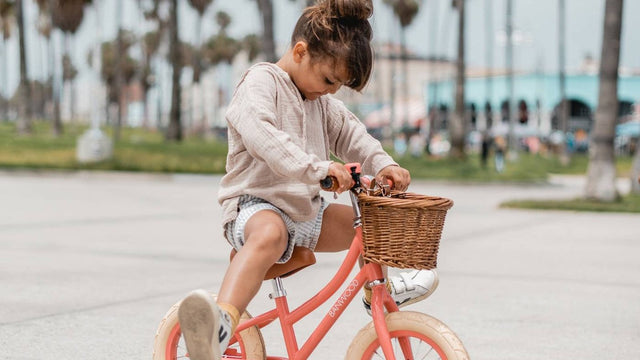
A balance bike is usually the first thing a toddler rides that can actually tip, so it is the moment the helmet habit starts. The Babelio baby balance bike ($78) is listed for 10–36 months with a seat that adjusts from 9.5 to 11 in, and the Aida Kids 2-in-1 Mini ($89.90) starts as a three-wheeler for 18 months to 3 years and converts to two wheels.

There is no rush toward pedals. The AAP says not to push a child onto a two-wheeled bike until about age 5 or 6, and to buy a bike that fits now rather than one to grow into. For more options by age, see our guide to the best bikes and tricycles for toddlers.
First scooters and ride-ons
The AAP's advice is to have children wear helmets as soon as they start to ride scooters or tricycles, so the helmet belongs in the same order as the scooter. The Scoot and Ride Highwaykick 1 ($145) is listed for 12 months to 5 years: it starts as a seated ride-on with a 44 lb seat limit, then the seat folds away and it becomes a stand-up kickboard rated to 110 lb. The Push and Go version ($160) adds a parent push bar for ages one to three.

If your child is still in the sit-and-scoot stage, our best ride-on toys by age guide and the best outdoor toys for toddlers cover what comes before the scooter.
What size helmet does a toddler need?
A toddler needs the helmet size whose printed head-circumference range includes their own measurement. Age is only an estimate. As a guide from the listings above, the Scoot and Ride XXS fits 17.7–20 in (ages 1–3), the Linus XS fits 48–52 cm, about 18.9–20.5 in (est. 1–5 years), and the Linus Small fits 52–54 cm (est. 5–10 years).

How to measure:
- Use a soft tape measure, or a piece of string you can lay against a ruler afterward.
- Wrap it around the widest part of the head: just above the eyebrows and ears, and around the bump at the back.
- Keep it level and snug, read the number, then measure again. Toddlers move.
- Match the number to the maker's range. If your child falls between two sizes, follow that maker's sizing advice on the product page.
Do not size up for growth. A dial and pads fine-tune a helmet that is already the right size; they cannot rescue a shell that is too big. The AAP notes that a child's helmet should fit for several years, since most models have fitting pads that can be swapped for thinner ones as the head grows.
What the CPSC bike helmet standard covers
The U.S. bicycle helmet standard is 16 CFR Part 1203, and it applies to every bicycle helmet manufactured after March 10, 1999. It requires four performance tests: peripheral vision (at least 105° to each side), positional stability (the helmet must not roll off the test headform), retention strength (the strap system may not stretch more than 30 mm) and impact attenuation (peak acceleration may not exceed 300 g).

Two details matter for toddlers. First, the standard sets a separate impact test line for helmets intended for persons age 1 and older than for helmets intended only for ages 5 and up, so a toddler helmet is tested as a toddler helmet. Second, a multi-purpose helmet marketed for general use counts as a bicycle helmet under the rule, while one marketed exclusively for another activity, such as skateboarding, does not.
In practice: the AAP says to only buy a helmet that meets the CPSC bicycle helmet standard, that any helmet meeting it is labeled, and to check inside the helmet to confirm. Do that when the box arrives.
Can a baby wear a bike helmet?
Not before age 1. The American Academy of Pediatrics states that babies younger than 1 year old have relatively weak neck structure, and that neither helmets nor bike traveling is recommended for them. That covers bike seats and trailers as well as the helmet itself, and it is why the toddler helmets above start at age 1.

After the first birthday, weight is the thing to watch. The AAP points out that light helmets matter for small children whose necks may not comfortably hold a heavier one. Of the helmets here, only the Scoot and Ride listing prints a weight: 0.53 lb. Once your child rides as a passenger on the back of your bike, the AAP says they should be in a helmet for that, too. If you have any doubt about your own child's readiness, ask your pediatrician.
How a toddler helmet should fit
A toddler helmet fits when it sits level, covers the top of the forehead and stays put when your child shakes their head. The AAP's fit guidance takes about 30 seconds to run through:
- Square and level. The helmet sits squarely on top of the head, parallel to the ground when your child looks straight ahead.
- Forehead covered. It covers the top of the forehead. Tipped back, it will not protect the forehead.
- Brim check. Your child should be able to see the brim of the helmet when glancing up.
- Push, pull, shake. It should not move around or slide down over the eyes when you push or pull it, or when your child shakes their head.
- Chin strap snug. Adjust the chin strap so it fits snugly.

The parent reality check: the fight is rarely about fit, it is about wearing the thing at all. The AAP's helmet habit advice is to start early, wear your own helmet, and hold the line that no helmet means no ride. Magnetic buckles, which the Scoot and Ride, Linus and Doona helmets all have, help at the chin-pinch stage.
Toddler full-face helmets
A full-face helmet adds a chin bar that wraps around the jaw; a standard helmet leaves the face open. All five helmets above are standard open-face helmets, which is the usual choice for a toddler on a balance bike, trike or scooter at sidewalk speeds.

If you are considering a full-face helmet for a young rider on pump tracks or trails, check three things before buying: that it carries a bicycle helmet certification label, that its smallest head size actually includes your child's measurement, and how much it weighs, because a chin bar adds material and weight is what the AAP flags for small necks. Whichever style you choose, the federal standard requires at least 105° of side vision in each direction.
When to replace a kids' helmet
Replace a child's helmet after a serious fall or crash, when it no longer fits, or at the age limit the maker gives. The AAP says helmets should be replaced every 5 years, or in the manufacturer's recommended time frame, because materials degrade, and that a helmet that has been through a serious fall or crash should be retired.
The federal standard backs that up on the label itself: every bicycle helmet must carry a warning that impact damage may not be visible, and that a helmet that has sustained an impact should be returned to the manufacturer for inspection or destroyed and replaced. It also requires a warning that common substances such as solvents and bleach can damage a helmet invisibly, so clean it the way the label says, typically with mild soap and water.
The AAP also cites research that a helmet can decrease the risk of head injuries by about 85% among bicyclists, which is the reason to replace rather than make do. For more ways to get small legs moving, see our guides to the best balance boards for kids and first birthday gift ideas.
Shop all kids' helmets at EasyTot →
Frequently Asked Questions
What size helmet does a 2-year-old need?
Go by head circumference, not age. Measure around the widest part of your child's head, just above the eyebrows and ears, then match the number to the maker's range: the Scoot and Ride Baby Helmet in XXS lists 17.7–20 in, and the Linus Lil' Helmet in XS lists 48–52 cm (about 18.9–20.5 in).
Can a baby under 1 wear a bike helmet?
The American Academy of Pediatrics advises against it. Its HealthyChildren.org helmet guidance says babies younger than 1 year old have relatively weak neck structure, and that neither helmets nor bike traveling is recommended for them. The toddler helmets here start at age 1.
How do I know a toddler helmet is certified?
Look for the label inside the helmet. Every bicycle helmet made for the U.S. market after March 10, 1999 must meet the federal standard at 16 CFR Part 1203, and the AAP says any helmet meeting the CPSC standard is labeled. Among these picks, the Scoot and Ride and Linus listings name the CPSC standard outright.
Do toddler helmets need MIPS?
The federal bicycle helmet standard does not require MIPS; it tests peripheral vision, positional stability, strap strength and impact attenuation. None of the toddler-size helmets here lists MIPS. The Thousand Chapter MIPS Helmet does, but it comes in Small, Medium and Large rather than toddler sizes.
Can my toddler use a bike helmet on a scooter or balance bike?
Yes, a bike helmet is the right helmet for a balance bike, trike or kick scooter, and the AAP recommends helmets as soon as children start riding scooters or tricycles. The Scoot and Ride Baby Helmet is sold alongside the brand's Highwaykick scooters for exactly that.
When should I replace my child's helmet?
Replace it after any serious fall or crash, when it no longer fits, or when it reaches the age limit the maker gives. The AAP says helmets should be replaced every 5 years or in the manufacturer's recommended time frame, because materials can degrade over time.
Are dress-up helmets safe for riding?
No. Knight helmets, construction hard hats and other costume helmets are dress-up accessories for pretend play, not protective gear, and they are not bicycle helmets. For anything with wheels, use a helmet with a bicycle helmet certification label inside.