

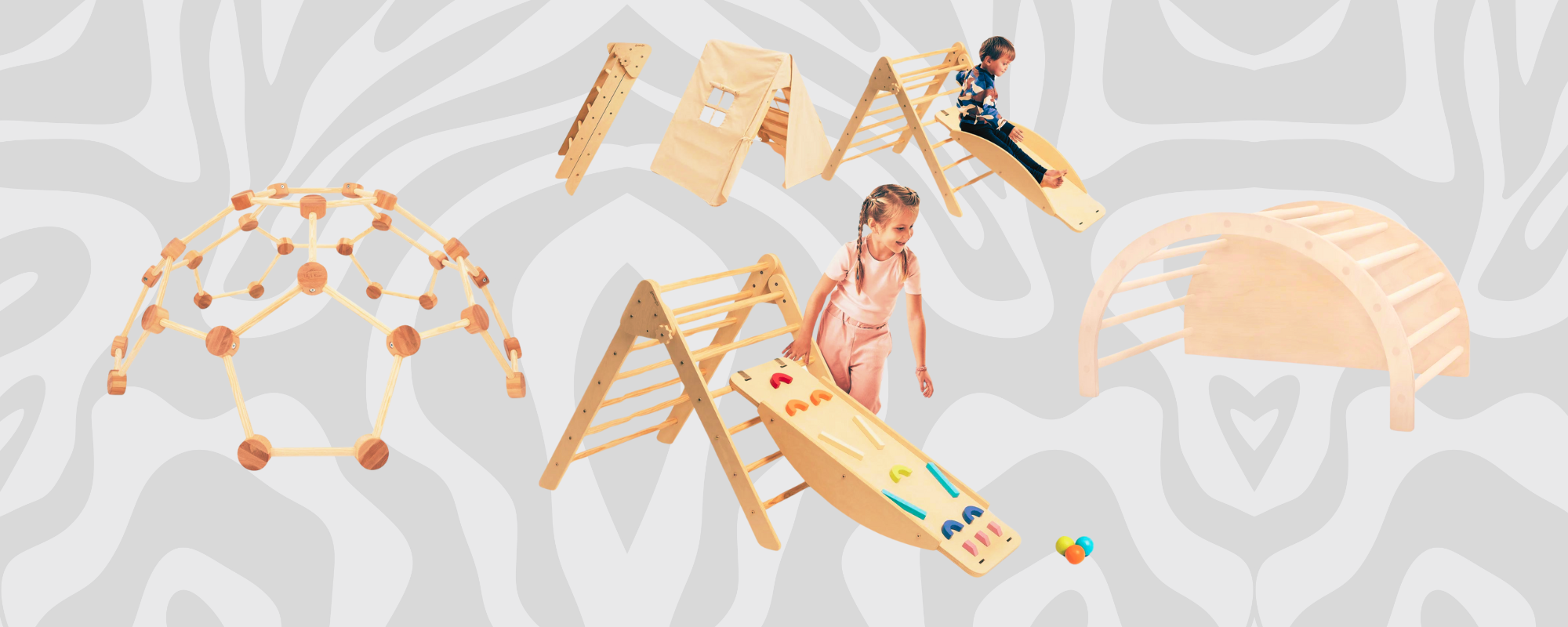
Best Pikler Triangles for Toddlers & Kids
The Pikler triangle — named after Hungarian pediatrician Dr. Emmi Pikler — has become one of the most beloved pieces of toddler climbing equipment in modern playrooms. Designed to let children explore movement at their own pace, these open-ended climbing structures build strength, balance, confidence, and spatial awareness from the earliest months of independent movement.
Whether you are setting up a Montessori-inspired playroom, looking for an indoor gross motor outlet on rainy days, or building a backyard obstacle course, this guide covers every climbing option available at EasyTot — plus several noteworthy brands from around the world.
- Why a Pikler Triangle?
- What to Look for in a Climbing Structure
- Little Partners — Classic Indoor Climbers
- FitWood — Premium Scandinavian Wall Bars & Arches
- Bijou Build — Modular Outdoor Play Systems
- More Climbing Brands at EasyTot
- Other Brands Worth Knowing
- Safety Tips for Indoor Climbing
- Frequently Asked Questions
Why a Pikler Triangle?
Dr. Emmi Pikler observed that children who are allowed to move freely — without being propped up, placed in walkers, or hurried through milestones — develop stronger bodies and greater confidence. Her research showed that self-directed climbing helps children learn to assess risk, build core and upper-body strength, and develop the vestibular system that governs balance.
A Pikler triangle translates these principles into a simple, sturdy wooden frame that toddlers can approach on their own terms. There is no right or wrong way to use it: a six-month-old might pull up on the lowest rung while a three-year-old scrambles over the top. That open-ended design is what makes it such a lasting investment — most children use theirs well into the preschool years and beyond.
Modern climbing equipment has expanded far beyond the original triangle shape. Today you will find climbing arches, wall bars, domes, rope bridges, wobble boards, and full modular play systems — all built on the same philosophy of child-led movement. Below, we break down the best options available at EasyTot and beyond.
What to Look for in a Climbing Structure
Age range and weight limit — Make sure the structure suits your child now and for at least the next two to three years. Most Pikler triangles support ages one through five; wall bars and modular systems often last through age twelve.
Material and finish — Look for solid hardwood or sustainably sourced birch plywood with non-toxic, water-based finishes. Avoid particleboard and painted surfaces that chip easily.
Foldability and footprint — If space is tight, a knock-down or foldable triangle is essential. Wall-mounted bars are ideal for smaller rooms because they leave the floor clear.
Modularity — Can you add ramps, slides, arches, or other accessories later? A modular system grows with your child and keeps the challenge fresh.
Safety certifications — Check for ASTM, EN71, or CPSC compliance. Look for rounded edges, non-slip rungs, and stable bases.
Little Partners — Classic Indoor Climbers
Little Partners is an American brand best known for their Learning Tower, and their climbing line applies that same philosophy of safe independence to gross motor play. The Learn 'n Climb Triangle is a solid hardwood Pikler triangle with a knock-down design that stores flat — a major advantage for families short on space. Pair it with the matching climbing ramp (smooth slide on one side, ladder rungs on the other) for a complete indoor climbing setup.

Learn 'n Climb Triangle (knock-down)
A beautifully crafted wooden Pikler triangle with knock-down design for easy storage. Encourages climbing, balancing, and imaginative play with a sturdy solid-wood frame and non-toxic finish.

Little Parters 2-in-1 Climbing Ramp / Slide
A versatile ramp that pairs perfectly with the Learn 'n Climb Triangle. One side is a smooth slide, the other features climbing rungs for an extra challenge.

Climbing Ladder
An add-on climbing ladder that attaches to the Learn 'n Climb Triangle, giving toddlers more ways to explore vertical movement and build strength.

Wobble Board
A curved wooden balance board that encourages core strength and proprioceptive development. Great as a standalone toy or paired with climbing structures.
FitWood — Premium Scandinavian Wall Bars & Arches
FitWood is a Finnish company that brings minimalist Nordic design to children's climbing equipment. Their wall bars are a statement piece — tall, slim birchwood ladders that mount flush against the wall and serve as both a climbing structure and room decor. The Luoto climbing arch doubles as a rocker for babies and pairs with a matching cushion for quiet reading time. Every FitWood product is made from sustainably sourced Finnish birch and designed to last a lifetime.

Wall Bars Aarni 7'2"
Premium Finnish-designed wall bars standing 7 feet 2 inches tall. Made from sustainably sourced birch with a minimalist Scandinavian aesthetic that doubles as room decor.

Wall Bars | Taimi 7'2"
Sleek wall-mounted bars with an adjustable pull-up bar and multiple grip positions. Designed to grow with your child from toddlerhood through the teen years.

Climbing Arch & Rocker | Luoto
A multifunctional climbing arch that doubles as a rocker. Pair it with the Kaura cushion for a cozy reading nook or flip it over for an exciting climbing challenge.

Mini Gym Rings Ulpu
Wooden gym rings with adjustable straps that hang from a doorway or ceiling mount. Perfect for developing upper body strength and coordination.
Bijou Build — Modular Outdoor Play Systems
Bijou Build takes a different approach: powder-coated steel frames designed for outdoor use. The Mainstay is the foundation piece — a sturdy A-frame that supports add-ons like rope bridges, swings, climbing panels, and platforms. This is the system for families who want a backyard climbing setup that can evolve as kids grow. The modular design means you can start with just the Mainstay and add pieces over the years, keeping the challenge fresh through age twelve and beyond.

Bijou Build Mainstay
A modular outdoor climbing structure made from powder-coated steel. The Mainstay is the foundation piece that supports add-ons like rope bridges, swings, and more.

Rambler Rope Bridge
An exciting rope bridge add-on for the Bijou Mainstay. Challenges balance and coordination while giving kids an adventurous obstacle course element.

Bijou Sway
A simple, elegant swing seat that attaches to the Bijou Mainstay A-frame. Made from durable materials with a comfortable, kid-friendly design.


Bijou A Frame Swing Arm Adaptor Kit
Converts your Bijou Mainstay into a swing set. The A-frame adaptor provides a sturdy mounting point for the Bijou Sway and other swing attachments.
More Climbing Brands at EasyTot
Beyond our featured collections above, EasyTot carries climbing and active-play products from many more brands. Some of these collections are still being built out — check back often as we continue to add new products and brands to the store.


Goodevas
A Ukrainian brand offering an extensive range of Montessori climbing equipment including Swedish walls, triangle ladders, climbing arches, and slide boards. Known for beautiful natural wood finishes and comprehensive play sets. Ages 6 months–9 years.


Kidodido
Colorful, whimsical climbing sets from Lithuania featuring Pikler triangles, climbing arches with cushions, and modular play systems. Their patterned cushion sets (space, flamingo, origami) add a fun design element. Ages 1–6.


woodandhearts
Ukrainian artisans creating impressive indoor climbing structures from climbing domes and jungle gyms to full-scale wooden playgrounds and monkey bars. Premium solid wood construction for serious climbers. Ages 1–8.


Ette Tete
Latvian designers behind the iconic MOPITRI modifiable Pikler triangle, FIPITRI five-segment climbing frame, and CUBITRI climbing cube. Modular, expandable systems that grow with your child. Ages 6 months–6 years.


Tiny Land
Affordable, colorful climbing sets including 7-in-1 rainbow climbing systems with Pikler triangles, arches, ramps, and play pads. A great entry point for families exploring Montessori climbing. Ages 1–5.


RAD Children's Furniture
American-made Montessori furniture and climbing equipment including classic Pikler triangles, climbing arches, and ladders in clean, natural wood finishes. Built to last. Ages 1–6.


Bunny Hopkins
Handcrafted Pikler triangle sets, climbing arches, and stepping stones in soft pastel colorways. Their meadow and diversity-themed designs bring warmth to any playroom. Ages 1–5.


GrowGo Kids
Innovative climbing arches with tabletop conversions — flip the arch over and it becomes a kids' table. Includes matching cushion pillows for comfort. Ages 1–5.


ShopMyLittleSongbird
Handmade wooden climbing triangles, ramps, and baby swings in a range of natural and painted finishes. Small-batch quality with artisan craftsmanship. Ages 6 months–5 years.


Lillagunga
Premium Finnish gym equipment for children — beautifully designed wooden rings, swings, and trapeze bars with adjustable ropes. Minimalist Nordic design that looks stunning in any home. Ages 3+.
Other Brands Worth Knowing
The Pikler and Montessori climbing space is rich with independent makers and specialty brands from around the world. These companies are not currently carried at EasyTot, but they are well-regarded in the community and worth exploring if you are looking for something specific.
Wiwiurka
A family-owned Mexican brand crafting heirloom-quality Pikler triangles, climbing arches, and jungle gyms from certified European pinewood. Available in 13 stunning colorways with non-toxic finishes. Starting around $300 for individual pieces.
Piccalio
Sustainably sourced, foldable climbing triangles designed for ages 6 months to 6 years. Their mini climber set is a space-saving option with a lead-free, phthalate-safe finish. Popular for apartment living.
Cassarokids
FSC-certified foldable Pikler triangles and ramps available in a wide range of colorways using water-based paint. Multiple sizes to fit different spaces and age ranges.
Bella Luna Toys
Curated Waldorf and Montessori climbing toys including Pikler triangles in rainbow, pastel, and natural finishes. Known for thoughtful, screen-free play options for young children.
Lily & River
US-designed indoor climbing structures with a modern aesthetic. Their Little Climber Pikler triangle and bamboo balance boards are popular choices for design-conscious families.
Sprout Kids
Baltic birch plywood climbing triangles and arches designed and manufactured in Europe. Their modular approach lets you start small and add pieces as your child grows.
Safety Tips for Indoor Climbing
No matter which climbing structure you choose, a few universal safety practices will keep playtime worry-free.
Always place climbing structures on a soft surface — a thick play mat, foam tiles, or a folded quilt — to cushion any falls. Keep the area around the structure clear of hard furniture and sharp edges. Supervise young climbers without hovering; the goal is to let them assess risk and build confidence, while you stay close enough to catch a true fall.
Check hardware monthly for loose bolts or screws, especially on foldable structures that are assembled and stored frequently. Follow the manufacturer's weight limit and age recommendations, and remove any accessories (scarves, ropes, cords) that could pose a strangulation hazard when the structure is not in active use.
For wall-mounted bars, make sure you anchor into studs — not just drywall — and follow the manufacturer's installation guide exactly. A poorly mounted wall bar is the most common safety issue reported by families.
Frequently Asked Questions
What age is a Pikler triangle suitable for?
Most Pikler triangles are designed for children from about 6 months (when they start pulling up) through age 5 or 6. Babies will use the lowest rungs to practice standing, while older toddlers will climb over the top. Wall bars and modular systems like Bijou Build extend the useful age range well into the elementary years.
Is a foldable Pikler triangle as sturdy as a fixed one?
Quality foldable triangles like the Little Partners Learn 'n Climb are designed with locking mechanisms that make them just as stable as fixed models during use. The trade-off is usually a slightly higher price point for the folding hardware. Always check that the locking mechanism is fully engaged before each play session.
Do I need a mat under the climbing structure?
Yes, absolutely. A soft landing surface is the single most important safety measure. A thick foam play mat, interlocking foam tiles, or even a folded comforter will significantly reduce the risk of injury from falls. The landing zone should extend at least two feet beyond each side of the structure.
How much space do I need for a Pikler triangle?
A standard Pikler triangle needs a footprint of roughly 3 by 3 feet, plus at least 2 feet of clearance on every side. If you are adding a ramp or slide, plan for about 6 feet of total length. Wall bars require minimal floor space — just enough clearance for a child to hang and swing.
Can climbing structures be used outdoors?
Most wooden Pikler triangles are designed for indoor use — prolonged exposure to rain and sun will warp the wood and degrade the finish. Bijou Build's steel-frame system is specifically designed for outdoor use and is weather-resistant. If you want to bring a wooden climber outside temporarily, keep it in the shade and bring it back indoors after use.
What is the difference between a Pikler triangle and a climbing arch?
A Pikler triangle is an A-shaped frame with rungs on both sides, designed primarily for climbing. A climbing arch is a curved structure that can be used for climbing when upright and as a rocker when flipped over. Many families buy both and pair them with a ramp for a versatile three-piece climbing set.
Read more

As a parent, you care about what touches your child’s skin, what goes into their mouth, and what surrounds them as they grow. But with thousands of baby brands on the market, figur...
Read more
Best Halloween Costumes for Toddlers
Best Halloween Costumes for Toddlers 36 adorable dress-up costumes for little adventurers — from brave firefighters and magical princesses to fierce dragons and stealthy ninjas. Halloween i...
Read more