

 Buying guide
Best Dolls & Pretend Play Toys 2026
 ·
April 1, 2026
·
April 1, 2026
Last updated: October 2026
The best dolls for imaginative play are the ones with a soft, supportable body, a calm face, clothes a child can take off alone and no batteries — which is why our top picks are the HABA Snug Up doll ($19) for babies, the Miniland 15-inch baby doll ($62) for 2- to 4-year-olds, and an 18-inch Beautiful Curly Me doll ($67) for 5 to 8. Everything below is a doll or pretend play toy you can buy today, sorted by your child's age and then by type.
Start with the picks table, jump to your child's age, then browse the type sections — soft first dolls, diverse baby dolls, dollhouses, doll furniture, play kitchens, play food, pretend play toys and dress-up. The buying advice (what makes a doll good for open-ended play, how doll play changes year by year) sits below the products, where you can read it once you know what you are choosing between.
When a toddler feeds a doll, cooks dinner in a play kitchen or dresses up as an astronaut, they are rehearsing the grown-up world: taking care of someone, following a sequence, negotiating a role with a sibling. You don't need to buy everything at once — one doll and one thing for the doll to do is enough to start, and the rest can follow your child's interests.
The Best Dolls for Imaginative Play: Our Picks
If you only read one section, read this one. These are the specific dolls and sets we would buy, ordered youngest to oldest, with the reason each earns its place rather than a list of features. Every price is the live price on the product page today.
| Doll or set | Best age | Price | Why this one | |
|---|---|---|---|---|
 |
HABA Snug Up Doll Lauren | 6 months+ | $19 | The doll to buy before the first birthday: an all-plush body, machine washable cold, and light enough for a baby to drag around by one arm without anyone getting hurt. |
 |
Apple Park First Baby Doll | 12 months+ | $29 | A 9-inch organic-cotton doll with a rattle and squeaker sewn inside, so it doubles as a sensory toy for a child who is not yet pretending. |
 |
HABA Cari 12-inch Soft Doll | 12 months+ | $30 | Embroidered face, a dress on hook-and-loop fastener that a one-year-old can pull off, and a beanbag bottom so she sits up at the tea party. Machine washable cold. |
 |
Miniland Baby Doll 15-inch | 2 years+ | $62 | The step up to real caregiving play: a fully articulated 15-inch soft-vinyl body that can be posed sitting, standing or lying down like a real baby, and it is washable. |
 |
Miniland Diverse Baby Dolls | 3 years+ | $62 | The same doll across a genuinely wide range — multiple skin tones plus dolls with Down syndrome, glasses, a cochlear implant and vitiligo. Rare at this price. |
 |
Mentari Doll Furniture Bundle | 2 years+ | $57 | Accessories are what extend doll play from minutes to afternoons. A crib and a high chair with a flip-up tray give the doll a routine to be put through. |
 |
Kiboo Kids Coloring Doll | 3 years+ | $32 | The child designs the doll's clothes with the four washable markers included, washes the cotton doll and starts again. Good for a child who likes making more than nurturing. |
 |
Tender Leaf Cottontail Cottage | 3 years+ | $189 | A first dollhouse that comes furnished: shutters, cut-out windows, an attic you can turn into a bedroom and a retro furniture set in the box. About 17 inches wide. |
 |
Beautiful Curly Me Bella Doll | 5 years+ | $67 | An 18-inch vinyl doll with washable curly hair and a little book of affirmations — the doll a 6-year-old treats as a friend with a personality rather than a baby to feed. |
 |
Plan Toys Victorian Dollhouse | 3 years+ | $460 | The buy-once option: three floors including an attic, sash windows that really slide, 1:12 scale so standard furniture fits, and a plain rubberwood finish that does not read as babyish to an eight-year-old. Furniture sold separately. |
One buying note that saves money: the doll matters less than what comes with it. A $30 first doll with a crib, a blanket and two changes of clothes generates far more play than a $60 doll on its own, because the accessories are what create the routine — feed, change, nap, repeat. If your budget is fixed, spend less on the doll and more on the things it needs.
Best first dolls for babies and 1-year-olds
The best first doll for a baby or 1-year-old is an all-fabric doll under 13 inches with embroidered features and a machine-washable body — the HABA Snug Up doll ($19, from 6 months) and HABA Cari ($30) are the two we hand to new parents first. At this age the doll is chewed, dropped from the high chair and slept on, so nothing hard, nothing that comes off and nothing that needs batteries.
What a 12-month-old actually does with a doll is imitate: offer it the bottle, pat its back, put a blanket over it. A doll that sits up on its own (Cari has a beanbag bottom) makes that easier, because the baby can put it down and come back to it. Apple Park's organic-cotton First Baby Doll ($29) adds a rattle and squeaker inside, which keeps a child who is not yet pretending interested in it as a sensory toy until they are.
Skip, for now: vinyl dolls (too heavy and too cold to cuddle), rooted hair (it gets chewed) and anything with a sound chip. A soft doll bought at six months is usually still the favorite at three; it just acquires a stroller and a bed along the way.
Best baby dolls for 3 and 4 year olds
The best baby doll for a 3-year-old is a 15-inch articulated vinyl baby doll that can be bathed, dressed and posed — Miniland's 15-inch dolls ($62) are our pick because the same doll comes in a wide range of skin tones and abilities, the body is washable, and every outfit and accessory in the line fits it. This is the age when doll play turns from imitation into caregiving, and a doll that can be fed, changed and put down for a nap in a crib is what carries it.
Buy the doll with its routine. The Mentari crib and high chair bundle ($57) is scaled to a 15-inch doll, and a couple of Miniland's knitted outfits give a 3-year-old the dressing practice that is most of the play. A fabric doll carrier ($25) lets a child wear the doll the way they see you wear a sibling, and it is the accessory that gets used every single day.
For a 4-year-old who already has a baby doll, the better gift is usually a second character rather than a bigger doll: a wooden doll family ($32, four posable figures) or a Lala + Mo doll with four outfits ($49) gives the stories a cast, which is what cooperative play at this age needs.
Best dolls for 5 and 6 year olds
The best dolls for 5 and 6 year olds are dolls with a personality rather than a baby to look after: an 18-inch Beautiful Curly Me doll ($67, with a book of affirmations), a Moulin Roty Rosalies rag doll ($70) with a printed face and long hair to style, or a Kiboo coloring doll ($32) the child redesigns every week. By five, play is multi-day narrative with fixed characters, so the doll needs to be someone, not something.
This is also the age for dress-up that changes who the doll is. Miniland's six professional outfits ($132 for the set, or $29 each — astronaut, scientist, cook, firefighter, farmer, artist) turn a 15-inch baby doll from toddlerhood into a cast of characters without buying a new doll. A 5-year-old who liked their baby doll usually loves it again once it has a job.
Hair matters now, and honestly: rooted vinyl hair mats permanently once it is brushed wet, while yarn, chenille and printed hair survive a six-year-old's salon. If the doll is going to be styled, choose yarn or molded hair, or accept that the hairstyle is a one-way trip.
Best dolls for 7 and 8 year olds
The best dolls for 7 and 8 year olds are jointed, soft-bodied dolls with removable, realistic clothing and no electronics — Llorens' 13.8-inch Sara ($130) and Elena ($90) have jointed arms and legs, phthalate-free vinyl and knit outfits that come off and go back on — plus a dollhouse to give the stories a place to happen. At seven the play is elaborate and private, so what helps is props, furniture and somewhere the set-up can be left standing overnight. Our Llorens dolls review compares every line — crying babies, newborns, soft-body babies and fashion dolls — by size and age.

Dollhouse play peaks here, not at three. An 8-year-old will furnish the Plan Toys Victorian Dollhouse ($460) room by room with 1:12 furniture, write the family's rules and come back to it for a year; a Tender Leaf Dovetail House ($280, six rooms) does the same at a lower price. Either is a better seventh-birthday gift than another doll, because it gives every doll the child already owns somewhere to live.
For a 7-year-old who wants to collect rather than nurture, Quercetti's Magnetic Fashion Laura ($33, 29 magnetic outfit pieces, ages 5+) and the Floss & Rock wooden magnetic dress-up doll ($28, 19 pieces with a fold-out palace scene) scratch the outfit-changing itch of a fashion doll without the fashion doll.
Best alternatives to traditional fashion dolls for imaginative play
The best alternatives to traditional fashion dolls for imaginative play are dolls that look like children rather than adults, with realistic bodies and everyday clothes — a 15-inch Miniland doll dressed as a scientist or firefighter, a Beautiful Curly Me doll, a soft-bodied Llorens doll in a knit jacket, or a wooden doll family for the dollhouse. Everyday-style dolls are better than glam fashion dolls for imaginative play because the child supplies the story; a doll that arrives with a fixed glamorous identity leaves less room for it.

What to look for in a fashion-doll alternative: a body a child can pose and dress (jointed limbs, snaps or hook-and-loop rather than tiny buttons), a face that is calm rather than made-up, and a wardrobe of ordinary clothes — pajamas, raincoat, overalls — so the doll can go to school, to bed and out in the rain. Miniland sells all of those as separate outfits in three doll sizes, which is the practical reason it is the line we keep coming back to.
Two more that work: Kiboo Kids' color-in cotton dolls ($32), where the child is the designer and the outfit is washed off and redrawn, and Shining Light Dolls' rag dolls and wooden figure sets for families who want faith-based characters (there is more on those in our Catholic toys and gifts guide).
Baby & Toddler Soft Dolls
For babies and young toddlers, soft dolls are the perfect first companion. They're lightweight, huggable, and safe for the youngest kids to carry, cuddle, and — let's be honest — chew on. HABA's Snug Up dolls ($19–$20, from 6 months) are machine washable cold, a non-negotiable when your 10-month-old is dragging one through everything, while Apple Park's 12.5-inch organic-cotton kids dolls ($51) come with a removable muslin romper and headband for a toddler's first dressing practice.

Look for dolls with embroidered features rather than button eyes for babies under 12 months. Fabric dolls also tend to be lighter than vinyl or wooden options, which means fewer bruises when your toddler inevitably swings them around by one arm. Sarah's Silks' handmade organic cotton dolls ($58, 11 inches, 18 months to 8 years) have the simplest faces of any doll here, which is the point — a plain face can be happy, sad or asleep depending on the story. Moulin Roty's Rosalies rag dolls ($70, from 10 months) have a vintage, heirloom quality that makes them a beautiful nursery accent as well as a toy.
Diverse & Inclusive Baby Dolls
Representation matters, even in the toy box. Miniland makes anatomically correct baby dolls in a wide range of skin tones and ethnicities, and in three sizes (8¼, 12⅝ and 15 inches), from soft, lightly vanilla-scented vinyl that is washable and fully articulated. The same line includes dolls with Down syndrome, glasses, a cochlear implant and vitiligo at the same $62 price as every other 15-inch doll, which is what makes these dolls genuinely inclusive rather than a token gesture. Llorens Dolls takes realism further with soft bodies, lifelike faces and outfits that rival actual baby clothes.

For families who prefer a more stylized aesthetic, Tender Leaf's wooden doll families ($32–$63) have a Scandinavian-inspired charm with flexible limbs and painted details, in several skin tones. They're particularly nice for dollhouse play since they can sit, stand, and be posed in different positions. Beautiful Curly Me makes 14- and 18-inch dolls with natural curly hair, and Lala + Mo's hijabi doll comes with four outfits and a prayer rug.
Dollhouses
A dollhouse is the stage where all of your child's pretend play stories come to life. The investment is worth it — kids typically play with a good dollhouse from age 3 all the way to 7 or 8, and siblings will share it for years. Tender Leaf's Dovetail House ($280) is our top pick for quality and play value: six rooms, printed plywood floors in neutral colors and a footprint of about 27 by 16 inches, big enough for two children to work on different rooms at once. Le Toy Van's Bluebelle ($163) is a more compact three-story house whose front and roof open, and it still feels premium.

If space or budget is a concern, Wonder and Wise's Home Sweet Home Dollhouse ($68) delivers surprisingly good play value in a smaller footprint: four furnished rooms and a family of four in the box, and it folds up with a built-in handle, which matters if your child likes to move the dollhouse from room to room. At the other end, Plan Toys' Victorian Dollhouse ($460) is the one to buy once, with sliding sash windows and 1:12 scale so any standard dollhouse furniture fits; our Plan Toys brand guide and Le Toy Van brand guide compare the two makers' houses line by line.
One sizing rule: check the doll scale before the house. Tender Leaf and Le Toy Van houses suit their own 4-inch wooden families; a 15-inch baby doll does not live in a dollhouse at all, it lives in doll furniture.
Doll Furniture & Accessories
Once your child has a beloved doll, the accessories are where pretend play really takes off. Doll strollers are the single most popular accessory in this category — kids love pushing their dolls around the house and on walks. Le Toy Van's retro wooden stroller ($142, with a retractable canopy and a removable changing bag) is a showstopper that doubles as nursery decor, and Lullaby Rattan's handwoven doll strollers and high chairs are the heirloom version.

Doll carriers are the unsung hero of this category. Miniland's fabric baby doll carrier ($25) lets your toddler "wear" their baby doll just like they see you wearing their sibling, and the Tushbaby toy doll carrier ($38, ages 2–10) is a hip seat that mirrors the one many parents already use. It's one of those accessories that gets used every single day once discovered.
Then the routine pieces: a crib (Poppie Toys' rattan crib from $158, or the Mentari crib and high chair at $57), a feeding set (Le Toy Van's nursing kit and bag, $55, with a bottle, bib, diaper, plate and spoon scaled to 12- to 14-inch dolls) and two or three changes of clothes with big snaps. Miniland sells outfits for all three of its doll sizes — pajamas, raincoat and boots, overalls, dresses — so a child can dress the doll for the weather, which is most of what a 3-year-old wants to do.
Play Kitchens & Tea Sets
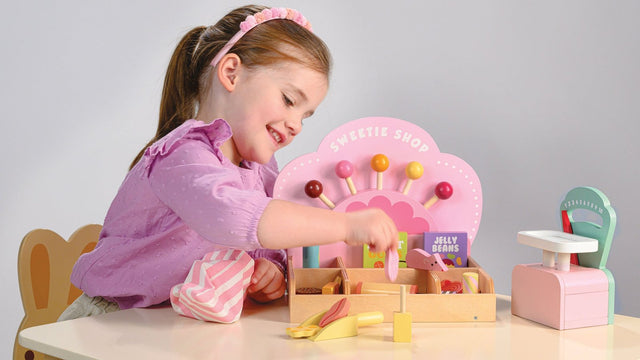
Play kitchens are the centerpiece of pretend play for most families. They encourage everything from cooking vocabulary and math skills (measuring, counting) to sharing and cooperative play with siblings and friends. Tender Leaf's Cherry Pie Kitchen ($138, about 17 inches wide and 25 tall) is the sweet spot of price, size, and play value — it comes with wooden utensils, it is sized for a 3-year-old, and it has enough features to keep kids engaged without dominating your living room.

Tender Leaf's Home Kitchen ($180) and Kitchen Range ($300) are the step-ups, and Le Toy Van's Family Size kitchen ($435) is the full-size option for two or three children cooking at once. If you're not ready for a full kitchen, Tender Leaf's Birdie Tea Set ($47, with two cups, saucers, a teapot and a cupcake on a tray) is a wonderful starter that teaches table manners and sharing in a low-key way.
Play kitchens are a big enough purchase to deserve their own comparison — see best play kitchens for sizing, wooden versus plastic, and which models fit a small apartment.
Play Food
Play food is the fuel for your child's pretend kitchen — and watching a 2-year-old "cook" you dinner is one of the purest joys of parenting. Le Toy Van's ice cream machine ($55) is a perennial favorite: the child sets a cone on the holder, picks a flavor with the switch and pulls the lever. Green Elephant's 30-piece beechwood cutting set ($38) teaches knife skills and food names simultaneously, with halves that split with a satisfying click.

For breakfast lovers, Tender Leaf's Breakfast Toaster Set ($44) is ridiculously charming — turn the birdie dial, the toast pops up, and there is a wooden knife, butter dish, poached egg and two slices of avocado to finish the plate. These small details are what separate quality play food from the generic stuff, and kids notice the difference. For a kitchen that needs stocking in one go, Le Toy Van's Supermarket Grocery Weekly Shop ($55) is a crate of pantry staples that also works for shop play.
Pretend Play Sets
Beyond the kitchen, pretend play sets let kids try on different roles — veterinarian, chef, shopkeeper. Le Toy Van's Animal Vet Set ($77) is a standout: a vintage-style medical bag with ten wooden accessories (paw balm, ear drops, a stethoscope), which adds an emotional caregiving element that kids gravitate toward once they bring their own stuffed animals as patients. Tender Leaf's BBQ set ($68) is perfect for outdoor imaginative play, and its General Stores ($178) is a whole shopfront with a till.

HABA's doorway play store ($60) deserves special mention — a telescopic bar extends from 28 to 50 inches to fit any standard doorframe, transforming your hallway into a shop, puppet theater, or lemonade stand in seconds. It rolls up for storage and is machine washable, which is a serious win for small spaces. For doctor play with a doll as the patient, Miniland's wooden doctor set ($58) is scaled to its 15-inch dolls.
For the wider case on why this kind of play matters — and how to join in without taking over — read the importance of pretend play for kids.
Dress-Up & Imagination
Costumes and dress-up accessories are pretend play in its purest form — no rules, no structure, just your child's imagination running wild. Sarah's Silks playsilks are the ultimate open-ended toy: a single 35-inch square of pure silk ($20) can be a cape, a river, a tent, a skirt, a tablecloth, or a magic carpet depending on the day, and the six-color primary set ($96) is the one to give a preschool classroom. For dress-up that doubles as sleepwear, the cotton pajama costumes in our Band of the Wild costumes review run from 3 months to 12 years.

For more structured dress-up, Souza's Andre astronaut suit ($47, 95% cotton) is impeccably made and comes in two sizes, while HABA's Eat-it-up dragon glove puppet ($16-inch, machine washable, with a belly bag for making things disappear) adds a theatrical element that gets the whole family involved in storytelling. Sarah's Silks' rainbow butterfly wings ($34) are the fairy option that survives a wash. For ready-made character costumes by age, see the most popular kids' costumes, and for a place to wear them, a play tent turns a corner of the room into the castle.
Pretend play toys by age
The best pretend play toys for toddlers are the ones that copy what the child sees you do every day — a doll with a bottle at 12 months, a play kitchen with a few pieces of food at 2, a doctor or shop set at 3 — and the best pretend play toys for kids of 5 and up are the ones that give an existing story a setting: a dollhouse, a costume, a doorway store. Use the table to see what to add next; everything in it links to the matching section or collection.

| Your child is | Start with | Add next | Where to look |
|---|---|---|---|
| 6–18 months | One soft doll and a blanket | A doll bottle or a soft doll carrier | Soft dolls · doll accessories |
| 18 months–2 years | A play kitchen or a toaster set with 6–10 pieces of food | A doll crib or stroller, a doorway store | Play kitchens · play food · doll furniture |
| 2–3 years | A 15-inch baby doll with two outfits | A second doll (siblings and friends need their own), cutting food | Dolls for 3 and 4 · diverse dolls |
| 3–4 years | A role set: vet, doctor, shop or tea set | A first dollhouse with its furniture, a costume with a zipper | Pretend play toys · dollhouses |
| 5–6 years | A doll with a personality and a job outfit, playsilks | A big dollhouse, a puppet, a play tent | Dolls for 5 and 6 · dress-up |
| 7–8 years | A jointed doll with real clothes, 1:12 dollhouse furniture | Magnetic dress-up dolls, a general store or ice cream cart | Dolls for 7 and 8 · pretend play sets |
Two things the table cannot tell you. First, a toddler pretend play toy only works if the child has seen the real thing — a 2-year-old who has never been to a vet will use the vet bag as a handbag, which is fine. Second, pretend play toys and building toys feed each other from about age 3: blocks become the dollhouse's garage, the dollhouse becomes the reason to build. Buying one of each is better than two of either.
What Makes a Doll Good for Open-Ended Play
Dolls that get played with for years share a handful of unglamorous traits, and none of them appear on the front of the box.

A body that has to be supported
Soft, floppy-limbed dolls demand two hands and a supported head, which is exactly what turns holding into caregiving. A stiff, light doll can be carried by one ankle, and mostly is. This is the single biggest difference between a doll that gets nurtured and a doll that gets dropped behind the sofa. Miniland's articulated vinyl body and Llorens' soft-torso dolls both pass; so does any rag doll.
A face that does not tell the child how to feel
A neutral, calm expression lets the doll be happy, sad, sick or asleep depending on the story. A permanently grinning face fights the narrative. For the same reason, avoid dolls that talk, cry or giggle on a battery: every sound the toy makes is a decision taken away from the child, and battery dolls are usually abandoned once the novelty goes. (Llorens' crying baby dolls have an off switch; use it.)
Clothes that a small child can actually remove
Dressing and undressing is most of the play, and it is genuine fine-motor work. Look for large snaps or hook-and-loop fasteners, not tiny buttons sewn onto a doll whose arms do not bend. If the clothes are sewn on permanently, half the play value is gone before you start. This is the same reason Montessori-style dressing frames work — there is more on that in our Montessori toys guide.
Washability, honestly assessed
A doll that goes everywhere gets filthy. All-fabric dolls usually machine wash (HABA's say cold wash, air dry; Moulin Roty's say a 30°C wool cycle); vinyl-bodied dolls wipe clean but their rooted hair mats permanently once brushed wet. Molded or yarn hair looks less pretty in the store and stays looking the same for years — worth knowing before you choose the one with long hair.
Size relative to your child
Around 15 inches is the sweet spot for a toddler: big enough to feel like a baby, small enough to carry and to fit doll furniture, which is mostly built to that scale. Very large dolls are unwieldy for under-3s, and very small ones tip into figurine play rather than caregiving. For a baby under one, 9 to 12 inches is the carryable size.
How Doll Play Changes From 1 to 6
Knowing what stage your child is actually at stops you buying the right toy two years early. Pretend play develops in a fairly reliable sequence.

- 12–18 months — imitation. Your child does to the doll what is done to them: offers it a bottle, pats its back, puts a blanket on it. Single actions, no story. All they need is one soft doll and a blanket.
- 18 months–2 years — short sequences. Actions link up: feed the doll, then wipe its face, then put it to bed. This is when a crib, a high chair or a stroller starts earning its space.
- 2–3 years — parallel play with scripts. Children play near each other rather than with each other, each running their own story out loud. Narration is constant and is doing real language work. A second doll prevents most of the conflict.
- 3–4 years — cooperative roleplay. Roles get assigned and negotiated ("you be the baby"), and the story survives interruptions. This is the age dollhouses and themed sets (vet, shop, kitchen) suddenly click, because the play now needs a setting.
- 5–6 years — elaborate narrative. Multi-day storylines, invented rules, dolls with fixed personalities and histories. Fewer new toys needed; what helps is furniture, small props and somewhere the setup can be left standing overnight (our playroom organization guide covers how to give a dollhouse a permanent home).
- 7–8 years — private worlds. The play goes quiet and goes indoors: long solo sessions with a dollhouse, dolls with jobs and back-stories, clothes changed for every scene. New dolls matter less than new props, and a child this age will tell you exactly which prop.
Two caveats. The ages are averages and the spread is wide — a child who narrates elaborate stories at two and one who starts at three are both entirely typical. And skipping a stage is not a thing to engineer: a three-year-old still doing simple feed-and-nap sequences is consolidating, not behind.
Quick Verdict
Best First Doll: HABA Cari 12" Soft Doll ($30) — machine-washable, embroidered features, perfect size for small hands, and built to survive years of love.
Best Doll for 3 to 4: Miniland 15" Baby Doll ($62) — washable, posable, and the widest range of skin tones and abilities of any doll we carry.
Best Doll for 5 to 8: Beautiful Curly Me Bella ($67) — an 18-inch doll with a personality, a book and a box that becomes her bedroom.
Best Dollhouse: Tender Leaf Dovetail House ($280) — six rooms, a neutral finish, and it'll be a centerpiece through elementary school.
Best Play Kitchen: Tender Leaf Cherry Pie Kitchen ($138) — ideal balance of features, size, and price. Enough to spark imagination without overtaking your living room.
Best Open-Ended Toy: Sarah's Silks Emerald Playsilk ($20) — one silk, infinite possibilities. The rare toy that grows with your child from toddler through grade school.
Best Budget Pick: Miniland Baby Doll Carrier ($25) — inexpensive, gets used daily, and teaches nurturing behavior in the sweetest way.
Shop all dolls & doll accessories at EasyTot →
Frequently Asked Questions
At what age do kids start pretend play?
Basic pretend play starts around 12-18 months — you'll see your toddler "feed" a doll or hold a toy phone to their ear. More complex scenarios (cooking a meal, running a shop, acting out stories) develop between 2-3 years. By age 4-5, kids engage in elaborate collaborative pretend play with friends and siblings.
What is the best doll for a 7 year old?
The best doll for a 7-year-old is a jointed, soft-bodied doll with removable real clothes and no electronics — a Llorens 13.8-inch doll ($90–$130) or an 18-inch Beautiful Curly Me doll ($67) — paired with a dollhouse or 1:12 furniture, because at seven the play is long, private and story-driven. A new doll matters less than new props.
Are glam fashion dolls or everyday style dolls better for imaginative play?
Everyday-style dolls are better for imaginative play. A doll that looks like a child in ordinary clothes — a Miniland 15-inch doll with a scientist or firefighter outfit, a soft-bodied Llorens doll in a knit jacket — leaves the story to the child, while a glam fashion doll arrives with a fixed identity and a narrow script. Jointed limbs and a plain face matter more than a wardrobe.
Are dolls just for girls?
Absolutely not. Boys benefit from doll play in exactly the same way — it builds empathy, nurturing skills, and emotional vocabulary. Miniland and Llorens both make boy dolls across every skin tone, and HABA's Snug Up line includes boys. If your son shows interest in dolls, encourage it. The same goes for play kitchens, tea sets, and other caregiving-themed toys.
Are display-quality dolls available for children?
Yes, but they are a different purchase. Heirloom dolls such as Moulin Roty's limited-edition Les Parisiennes and handmade Waldorf dolls ($260) are made to be kept and displayed as much as played with. Under about age six a washable play doll earns far more use; buy the display doll as the keepsake and a $20–$60 doll as the one that goes everywhere.
How do I choose the right dollhouse size?
Consider three things: the age of your child (bigger houses work better for younger kids with less fine motor control), the space you have available, and whether siblings will play together. A six-room house like the Tender Leaf Dovetail (about 27 inches wide) lets two children work on different rooms. For apartments, look for houses under 24 inches wide, or one that folds like Wonder and Wise's Home Sweet Home. Check the doll scale too — 1:12 houses take standard furniture, and a 15-inch baby doll does not fit any dollhouse.
Is wooden play food better than plastic?
Wooden play food is heavier, more durable, and has a more satisfying tactile feel. It's also quieter when dumped out of a basket (which happens constantly). Plastic food has the advantage of being lighter and sometimes more realistic-looking. For durability and aesthetics, we lean toward wood. For a massive variety of foods at lower cost, plastic has its place.
How much should I spend on a play kitchen?
A wooden play kitchen runs from about $138 (Tender Leaf's Cherry Pie) to $500 (the La Fiamma Grand Kitchen), and most kids use one for 3-5 years, making it one of the best cost-per-play-hour investments you'll make. Tender Leaf's Birdie Tea Set at $47 is a great entry point if you're not ready for a full kitchen. If you go bigger, the Cherry Pie ($138) and Home Kitchen ($180) are the sweet spot of quality and value.
How many pretend-play toys does a toddler actually need to start?
Just one or two. A single soft doll or a small pretend-play set is enough to spark imaginative play — kids don't need a full kitchen and dollhouse on day one. Watch what your child gravitates toward (caregiving, cooking, dress-up) and add pieces gradually as their imaginative play develops.
What are the best pretend play toys for a 2 year old?
For a 2-year-old, the best pretend play toys copy what the child watches you do: a 15-inch baby doll with a bottle and a crib, a small play kitchen or a toaster set with a few pieces of food, and a doll stroller for walks. Skip role sets (vet, shop) until about three — a 2-year-old uses the vet bag as a handbag, which is fine but not what you paid for.
What are good dolls with accessories for imaginative play?
Look for a 15-inch doll paired with a crib, a high chair, a stroller and two or three changes of clothes with large snaps — the accessories are what turn holding a doll into a routine of feeding, changing and naps. The Mentari doll furniture bundle ($57) plus a Miniland 15-inch doll ($62) is the combination we would pick; Miniland and Apple Park both sell doll clothes that fit the same scale.
What makes a doll good for open-ended play?
A soft, floppy body that has to be supported with two hands, a neutral facial expression that lets the doll be happy or sad depending on the story, clothes a small child can remove unaided, and no batteries. Every sound a doll makes on a battery is a decision taken away from the child, which is why talking dolls are usually abandoned quickly.
Do dolls need to be washable?
For a doll that leaves the house, yes. All-fabric dolls generally machine wash (HABA's Snug Up and Cari dolls wash cold) and are the safer choice for a first doll. Vinyl-bodied dolls like Miniland's wipe clean easily but their rooted hair mats permanently once it is brushed while wet — molded hair looks plainer in the store and stays looking the same for years.
Keep reading
 GearLlorens Dolls Review 2026: Crying Baby Dolls, Newborns and Fashion Dolls, Sizes, Ages and What to Buy
 GearLorena Canals Washable Rugs Review: Are $200-$600 Machine-Washable Rugs Worth It?
 GearBest Step Stools & Learning Towers for Toddlers (2026)
 GearBest Outdoor Toys for Toddlers: Active Play Guide (2026)
 GearBest Baby Blankets 2026
 GearBest Kids Headbands & Hair Accessories 2026
 GearBest Stroller Wagons 2026: WonderFold, Veer, Keenz & Evenflo Compared
 GearBest Kids Sweaters & Layers 2026
 GearBest Washable Rugs for Kids & Nurseries 2026
 GearBest Nursery Rugs 2026: Washable, Non-Toxic and Natural Picks
 GearBest Christmas Decor & Holiday Stockings 2026
 GearBest Play Couches for Kids
 GearBest Balance & Wobble Boards for Kids (2026)
 GearCatholic Toys and Gifts for Kids: A Guide by Occasion
 MilestonesImportance of Pretend Play for Kids 2026
 GearBand of the Wild Costumes Review 2026: Pajama Costumes, Baby Dragons & Sizing — What to Buy